How to improve your pop-up technique
Foot placement, hip lift, head position and home drills: how to fix a slow or unstable pop-up that is holding your surfing back.

The pop-up is the moment that separates a wave caught from a wave missed. Done well, it takes less than a second: hands plant on the deck, hips lift, feet land in stance, eyes already looking down the line. Done poorly, it adds two seconds of knee-drop, foot-shuffle and balance correction that almost always end with the wave passing or the board nose-diving. Most intermediate plateaus in surfing come from a pop-up that is technically functional but slow, and the rider does not realize it.
The fix is rarely strength. It is foot placement, hip lift mechanics, eye position and the absence of the knee-on-board stop that beginners learn and never unlearn. This guide breaks down the pop-up into its mechanics, the most common mistakes, drills you can do on dry land before any session and the small adjustments that turn a two-second pop-up into a half-second one. The result is more waves per session and a far more stable position on the board.
- A clean pop-up is one fluid motion: hands plant, hips lift, feet land in stance, no knee-on-board pause.
- Foot placement is roughly shoulder-width with the front foot at the board's sweet spot.
- Eye position pulls the body up; look forward at the wave shoulder, not down at the deck.
- Daily dry-land drills (twenty pop-ups per day) improve speed and stability faster than session time alone.
What a clean pop-up actually looks like
A textbook pop-up has four parts that happen in one motion. The hands plant flat on the deck near the chest, the hips lift in a small push-up, the back foot swings forward and lands first on the tail-area sweet spot, the front foot lands forward in stance. The whole sequence takes well under a second. The eyes look down the wave, not at the board. The chest is open, the knees are slightly bent, the arms are out for balance.
The contrast is the slow pop-up, which adds a knee-on-board step. Hands plant, then the back knee comes up to the deck, then the rider stands from kneeling. This works in flat water but is too slow for any green wave. The wave breaks under the kneeling surfer or the board slows down and the wave passes. Removing the knee-on-board step is the single biggest pop-up upgrade most intermediates can make.
- Hands plant flat near the chest, not in front of the head.
- Hips lift in a push-up motion, not a sit-up motion.
- Back foot swings forward first, lands on the sweet spot.
- Front foot lands forward; no knee touches the deck.
Foot placement: front and back
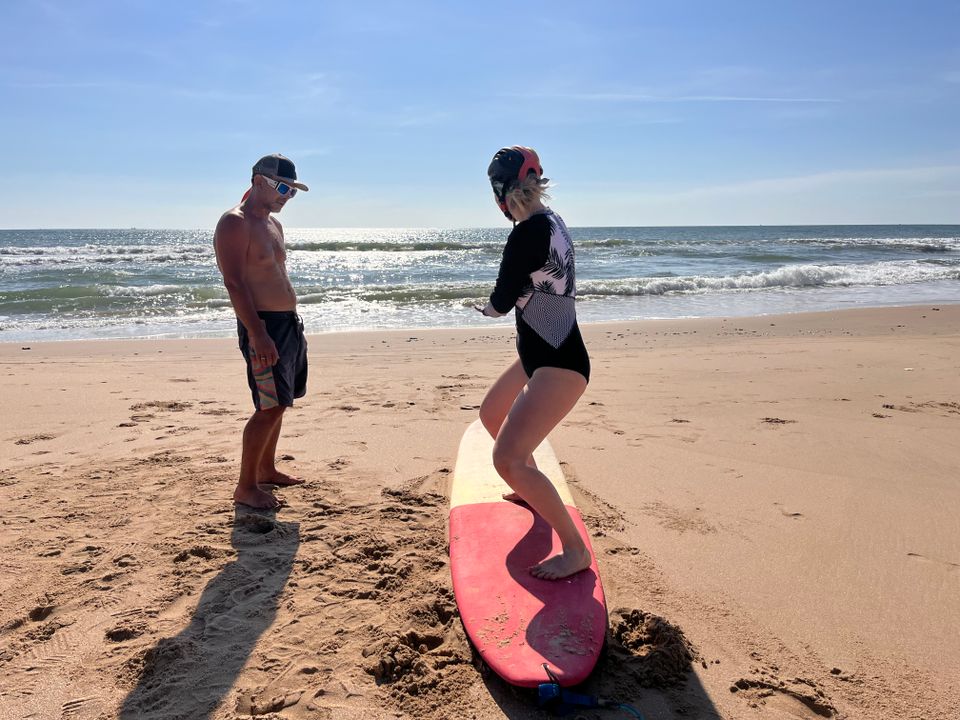
Foot placement decides whether the board nose-dives, stalls or trims. The back foot lives over the fins or just in front of them, depending on the board. On a foam board or longboard, the back foot is roughly two to three feet from the tail. On a shortboard, it sits directly over the back fins. The front foot lands roughly shoulder-width away from the back foot, angled slightly across the board (about 30 to 45 degrees from the centerline).
Too far forward and the nose digs underwater. Too far back and the board stalls without speed. The sweet spot is felt rather than measured: when the board planes flat with both edges in the water, you are in the right place. Channel Islands and JS Industries publish stance guides for their boards, and surf coaches recommend marking the sweet spot with a small wax bump the first time you find it so you can land there consistently.

The hip lift and eye position
The motion of the pop-up is closer to a push-up than a sit-up. The hands and hips do the work, not the abs. The hips lift first, the legs swing under, the feet land. If you try to sit up first or pull the legs up before lifting the hips, the timing breaks down and you either land in a half-kneel or fall forward. Surfer Magazine's coaching pieces and the ISA curriculum both teach this 'push up not sit up' framing.
Eye position pulls the body. Looking down at the board makes you stand up bent over and unstable. Looking forward at the wave shoulder (or where you are going) automatically lifts the chest, opens the hips and balances the stance. This is one of the easiest fixes for intermediate surfers stuck on slow pop-ups: keep the eyes up the entire time, never look at the deck.
- Push up motion, not sit-up; chest lifts, hips lift, feet land.
- Eyes look forward at the wave, never at the deck.
- Chest stays open and elevated; do not hunch over the board.
- Knees bent slightly on landing for shock absorption.
Common mistakes and how to fix them
Five mistakes account for most pop-up problems. First, the knee-on-board stop, which adds a full second. Fix: drill the no-knee pop-up on dry land until it is automatic. Second, hands too far forward, which makes the lift awkward. Fix: plant hands directly under the chest, not near the head. Third, looking down at the deck. Fix: pick a distant point on the horizon and look there before the pop-up starts. Fourth, feet landing too narrow or too wide. Fix: measure shoulder-width on dry land and repeat until consistent. Fifth, slow back foot. Fix: drill the back-foot swing in isolation.
Most of these come from how the pop-up was first taught. Beginner surf schools sometimes teach a knee-step pop-up as a transitional move; it works for the first whitewater rides but it must be unlearned for any real progression. The longer the knee step is practiced, the harder it is to remove. If you have one, address it directly with focused drills.
- Remove the knee-on-board stop; drill no-knee pop-ups daily.
- Plant hands under the chest, not near the head.
- Look forward at the wave, never at the deck.
- Land feet shoulder-width; mark the sweet spot with wax.
Dry-land drills that actually work
Twenty pop-ups a day on a yoga mat at home does more for pop-up speed than three sessions per week. The drill is simple: lie on the mat in surf paddle position, hands by the chest, then pop up in one motion to a surf stance, hold for one second, lie back down, repeat. Focus on form for the first ten, speed for the next ten. Add a 'look forward' cue: pick a spot on the wall and lock eyes on it during the entire pop-up.
Variations include the slow-motion pop-up (each phase for three seconds, to feel where weight transfers), the eyes-closed pop-up (to test body memory), and the partner pop-up (a friend yells 'go' and you pop up as quickly as possible from a relaxed prone position). The ISA coaching manual recommends these as standard drills for intermediate progression, and most surf strength programs (Surfset, Cris Mills) include them.
Before you go
- Remove the knee-on-board step; drill the no-knee pop-up daily.
- Plant hands under the chest, not near the head.
- Keep eyes forward, never on the deck.
- Land feet shoulder-width on the sweet spot; mark it with wax.
- Do twenty pop-ups a day on a mat between sessions.
FAQ
How fast should a pop-up be?
Under one second is the target for intermediate surfing, under half a second for advanced surfing on steep takeoffs. Most beginners land between one and two seconds and that is fine for whitewater. Once you start surfing green waves consistently, the pop-up needs to be under one second or you will miss takeoffs. Daily dry-land drills shrink the time more reliably than waiting for it to improve in the water.
Should I do a knee-step pop-up?
Some surf schools teach the knee step as a stepping stone for the first day. It works for prone whitewater rides where time does not matter. It does not work on green waves and is hard to unlearn once practiced. If you can, learn the no-knee pop-up from the start. If you already have the knee habit, focus on drilling the no-knee version until it replaces the old motion.
Where should my feet land on the board?
Back foot over or just in front of the fins, front foot roughly shoulder-width ahead of the back foot. On a foam board, this often means the back foot two to three feet from the tail and the front foot near the middle. The exact position is a sweet spot you find by experiment: when the board planes flat without nose-diving or stalling, you are in the right place. Mark it with a small wax bump.
Use BeachFinder to check today's spot.
Use your location, search any city worldwide or explore the map to compare the 20 most relevant beaches and swimming spots around you.
Download BeachFinder
Find beach conditions, sea temperature, wind, UV, water quality, and nearby swimming spots before you go.
These beach pages connect the guide advice with real spot details: sea temperature, wind, UV index, waves, access and photos when available.
Praia de Quarteira
PT
Playa de la Mata Negra
PT
Praia do Carvalho
PT
Plage Rive Gauche
FR
Plage de la Dalle
FR
Plage de Saint-Jean
FR
Praia dos Alemães
PT
Praia da Barra
PT
Plage du Lividic
FR
Lagoa de Albufeira
PT
Plage de Notre-Dame
FR
David
FR
Plage du Moulin Brûlé
FR
Praia dos Castelos
PT
Plage de La Folie Calette
FR