
Paddle-out techniques for beach breaks
Turtle roll, duck dive, channel reading and timing: how to get out the back without losing forty minutes to whitewater.
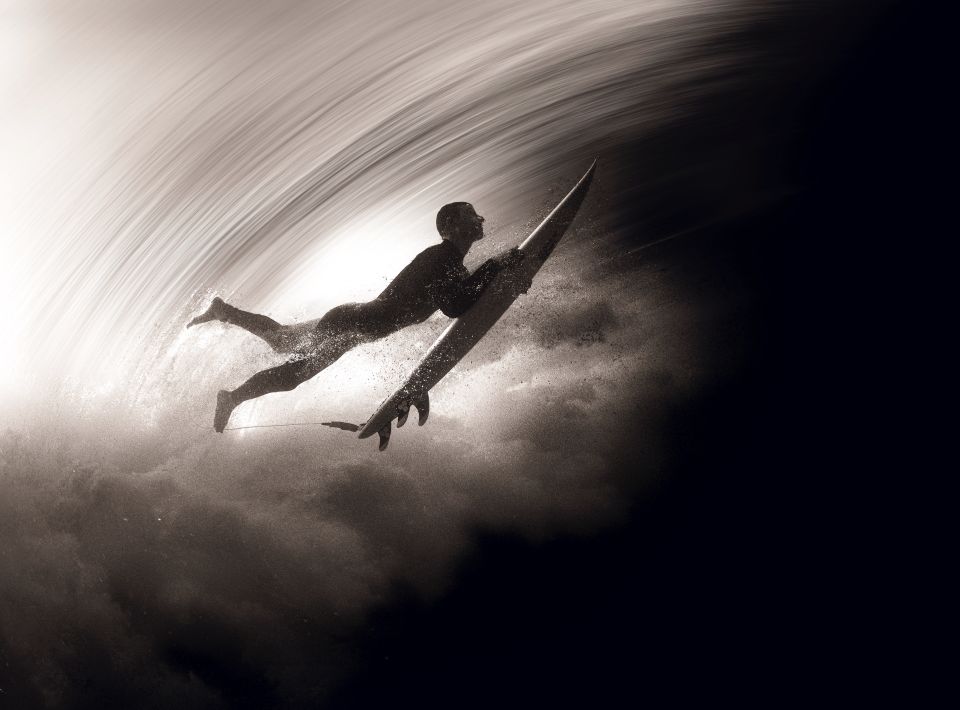
Most beginner surf sessions are not lost in the lineup. They are lost on the way out. Twenty minutes of paddling, three failed duck dives, two collisions with your own board and you arrive at the lineup with no arms left for the actual surfing. The good news is that paddling out is a learnable skill with concrete techniques. Once you can read a channel, time a set and execute either a turtle roll or a duck dive cleanly, the paddle-out shrinks from twenty minutes to five and your effective wave count doubles.
This guide covers the three paddle-out fundamentals: reading the beach for channels and rip currents that take you out efficiently, timing the sets so you do not paddle into the worst part of the cycle, and the two main techniques for getting your board past a breaking wave. The turtle roll for longboards and softops, the duck dive for shortboards. Both are well-documented in ISA and Surfline coaching materials, both take practice to do well.
- A channel (deeper water between sandbanks) is the fastest route to the lineup; learn to spot one.
- Time sets: paddle out between sets, not into the heaviest waves of a set.
- Turtle roll for foam and longboards: flip the board upside-down and hold tight as the wave passes.
- Duck dive for shortboards: sink the nose and tail with the wave, pop up behind it.
Read the beach before you paddle
Five minutes of watching the water beats fifteen minutes of paddling through whitewater. The first thing to identify is the channel: a strip of water where waves do not break or break less consistently than the surrounding zones. Channels exist because the water is deeper there, often on a sandbank gap or beside a jetty. They are the surf highway, and almost every experienced surfer uses them.
Channels look darker (deeper water) and often have a noticeable current pulling out. That current is a rip, and on a beach break it can do most of the paddling work for you. The same rip is dangerous for non-swimmers but useful for surfers who understand it. NOAA and the US Lifesaving Association publish detailed rip-current diagrams; spend a few minutes learning them so you recognize the visual signature.
- Darker water often indicates a channel; lighter foamy water indicates a breaking sandbank.
- Waves not breaking in a strip = channel.
- Rip currents flow outward through channels and can speed up the paddle out.
- If unsure, ask a lifeguard or a regular at the beach.

Time the sets
Waves come in sets, typically every 60 to 180 seconds depending on the swell period. Between sets, the water is much calmer and the paddle-out is dramatically easier. Watching for two or three sets before entering the water gives you the rhythm and lets you start paddling at the right moment. A poorly-timed paddle directly into the heaviest set is the single biggest reason beginners arrive at the lineup exhausted.
On a beach break with strong swell, the safest paddle-out window is in the first thirty seconds after a set finishes, when the next set is still building. On smaller days the rhythm matters less but the principle still applies. Surfline cam analysis and surf school instructors both teach this rhythm explicitly because it converts a tiring paddle into a manageable one.

Turtle roll: the longboard technique
On a foam board or longboard, duck diving is impossible because the board is too buoyant to push under. The turtle roll is the technique used instead. As the broken wave approaches, you grip the rails of the board firmly, roll over so the board is upside-down and you are underneath in the water, hold tight while the wave passes over the bottom of the board, then roll back up and keep paddling.
The key is to grip the rails near the front third of the board (not too far back), wrap your legs around the tail to keep the board with you, and let the wave wash over the bottom rather than the deck. If you let go, the board flies back to shore on the leash and you swim the rest. Practice the roll in calm water before a real wave; the mechanics are awkward at first and easier than they look once drilled.
- Grip the rails near the front third, not the middle.
- Roll the board upside-down before the wave hits, not during.
- Hold tight through the wave; do not let go of the board.
- Roll back up immediately and resume paddling.
Duck dive: the shortboard technique
On a shortboard or hybrid (under 50 liters of volume), the duck dive becomes possible. The board is small enough and the rider's weight strong enough to push the nose under the wave, then the tail, and pop up behind it. The technique looks effortless when a pro does it and requires real practice when you start. Beginners trying to duck dive an 8-foot foam board will fail; this is not a board problem, it is a buoyancy problem.
The sequence is: paddle hard at the wave, just before it breaks, press the nose underwater with both hands (one on each rail near the chest), use a knee or foot on the tail to push the back of the board down, glide under the breaking section, and let the buoyancy bring you back up behind it. JS Industries and Channel Islands shape board rocker partly to make duck diving easier on intermediate boards; the technique pairs with the equipment.
- Paddle hard at the wave; speed matters as much as technique.
- Press the nose under with both hands on the rails, not on the deck.
- Use a knee or foot on the tail to push the back down.
- Glide under the breaking section, pop up behind it.
Putting it together: a clean paddle-out
A good paddle-out combines all three skills. You watch from the beach and find the channel. You time your entry to the lull between sets. You paddle hard along the channel, using any rip current to your advantage. If a wave catches you, you turtle roll or duck dive depending on your board. You arrive at the lineup with enough energy to surf, not with arms made of lead.
Use BeachFinder to find beaches with clear channels and predictable sandbanks for early-stage learning. Some beaches (Hossegor in big swell, parts of Ericeira, exposed Cornish beaches) have heavy shore impact and no easy channel; these are not paddle-out training grounds for beginners. The beach you start on matters as much as the technique you practice.
Before you go
- Watch two or three sets before entering the water.
- Identify a channel: darker water, fewer breaking waves.
- Time your paddle-out to the lull between sets.
- Practice turtle roll in calm water before relying on it in waves.
- Start with duck dives only after dropping to a hybrid or shortboard.
FAQ
Can I duck dive a foam board?
Not effectively. Foam boards are too buoyant to push under a wave even for strong surfers. The technique on foam is the turtle roll: flip the board upside-down and hold tight as the wave passes over the bottom. Trying to force a duck dive on foam wastes energy and the wave usually pushes you back anyway. Switch to turtle roll until you transition to a hybrid or shortboard.
Is it safe to use a rip current to paddle out?
For experienced surfers, yes. Rip currents flow outward through channels and can take you to the lineup with less paddling. For non-surfers and beginner swimmers they are dangerous because the current can pull tired swimmers offshore. The difference is the board: a surfer floating on a foam or hardboard is safe in a rip in a way that a tired swimmer is not. Even so, never paddle out a rip you do not understand; ask a lifeguard if unsure.
Why am I getting pushed back every time I try to paddle out?
Three common reasons. You are paddling through the breaking zone instead of around it via a channel. You are timing the wrong moment, entering during a heavy set instead of in the lull. You are not paddling fast enough into the wave before turtle rolling or duck diving, so the wave catches you with no momentum. Address each in turn: channel, timing, paddle speed.
Use BeachFinder to check today's spot.
Use your location, search any city worldwide or explore the map to compare the 20 most relevant beaches and swimming spots around you.
Download BeachFinder
Find beach conditions, sea temperature, wind, UV, water quality, and nearby swimming spots before you go.
These beach pages connect the guide advice with real spot details: sea temperature, wind, UV index, waves, access and photos when available.
Praia de Quarteira
PT
Playa de la Mata Negra
PT
Praia do Carvalho
PT
Plage Rive Gauche
FR
Plage de la Dalle
FR
Plage de Saint-Jean
FR
Praia dos Alemães
PT
Praia da Barra
PT
Plage du Lividic
FR
Lagoa de Albufeira
PT
Plage de Notre-Dame
FR
David
FR
Plage du Moulin Brûlé
FR
Praia dos Castelos
PT
Plage de La Folie Calette
FR