Catching your first wave: from white water to green wave
Step-by-step progression from your first whitewater ride to your first unbroken green wave, with what each stage actually feels like.
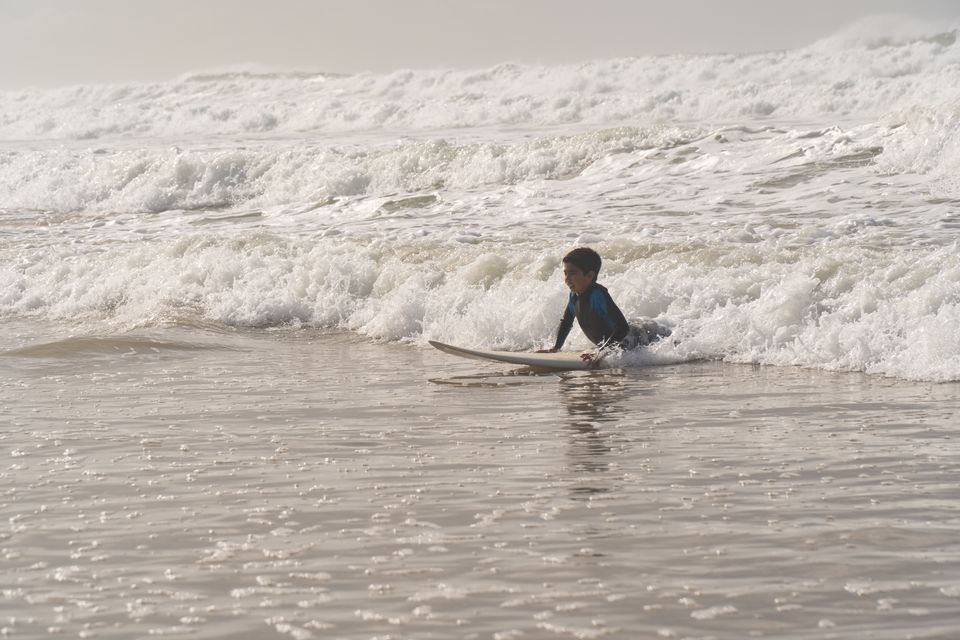
The first time you stand up on a surfboard is a memory that does not fade. For most beginners, that ride is in whitewater (the foam after the wave has already broken) on a foam board, with an instructor giving a push. The next steps are less photogenic but more important: catching whitewater by yourself, transitioning to unbroken (green) waves, learning to angle the takeoff and eventually paddling for waves without help. Each step is a real milestone with a specific feel and a specific skill to drill.
This guide walks through the progression in the order it actually happens. It is built on the curriculum used by ISA-certified surf schools and Federation Francaise de Surf programs, both of which break the first month into stages that match what your body and brain can absorb. The biggest mistake beginners make is rushing the steps: trying for green waves on day one, or paddling out the back before they can stand on a whitewater wave consistently.
- Whitewater on a foam board is the first stage; do not skip it, even if you are athletic.
- Standing up consistently in whitewater is the prerequisite for moving to green waves.
- Green waves require paddle speed, timing and reading the wave; the pop-up is the same.
- Angling the takeoff (going left or right instead of straight) is the entry to real surfing.
Stage 1: prone rides on whitewater
The first ride is almost always lying down. The instructor positions you with the board pointed toward shore in shallow water, waits for a small whitewater wave, gives the board a push and lets the wave carry you in. You hold the rails or the front of the board, keep your weight forward and just feel the speed. This is not 'real surfing' but it is the moment your body first registers what a wave feels like under a board.
Do this for ten or twenty pushes before standing up. Most beginners are impatient and want to stand immediately. The prone phase is teaching you how the board accelerates, how it tracks straight, and where on the board you need to be to keep the nose from diving. Surfers who skip this phase often fall off the front of the board for weeks because they never learned weight distribution lying down first.
- Lie centered on the board with the chest in the middle.
- Hold the rails firmly; do not grip the nose.
- Keep your head up and look toward shore.
- Practice ten to twenty prone whitewater rides before standing.

Stage 2: stand up in whitewater with a push
The first stand-up is usually with the instructor pushing you into a small whitewater wave. As the wave catches the board, you pop up to your feet (covered in the pop-up guide), stand for as long as you can and ride the foam in toward shore. This often lasts three to five seconds the first few times. The feeling is unmistakable: the board accelerates, you wobble, you ride, you fall. Repeat.
Consistency is the goal of this stage. Five rides standing for three seconds each is more useful than one ride of fifteen seconds followed by ten failed attempts. Build the muscle memory of the pop-up under real wave acceleration. Most beginners get five to ten successful stand-up rides in their first session and twenty to forty in their first three sessions. Surf schools structure the rotation to give each student that many attempts.

Stage 3: catch your own whitewater waves
The next progression is catching whitewater waves by yourself. You position the board pointed toward shore, watch for a wave coming behind, and as it approaches, you paddle three to five hard strokes to match the speed of the wave. The wave picks up the board, you feel the acceleration, you pop up. The skill that is new here is paddling at the right moment with enough power to match the wave speed.
Most beginners under-paddle. They give two soft strokes and wonder why the wave passes under them without catching. The right paddle is fast, deep, with the chest slightly arched up to lift the nose. Five hard strokes is the rough target. Surf schools often coach this from the water, calling out 'go, go, go' as the wave approaches because the timing window is short.
- Position pointed toward shore in waist-deep to chest-deep water.
- Watch for a wave behind; start paddling three to five seconds before it arrives.
- Paddle hard and deep, with the chest slightly arched.
- Feel the acceleration; pop up only when the board is moving with the wave.
Stage 4: the first green wave
Moving from whitewater to green waves (unbroken waves with an open face) is a major transition. The mechanics of the pop-up are the same, but everything around it changes. You are further from shore, in deeper water, sitting on the board between waves. You need to read the wave's takeoff angle, paddle into it at the right moment, and pop up before the wave breaks under you. This is when surfing starts to feel like the photos.
The first few green waves are usually small and forgiving. A knee-high to waist-high unbroken wave on a clean morning at a beginner-friendly beach is the right target. JS Industries' beginner curriculum and the ISA coaching manual both recommend starting on green waves only after the beginner can stand consistently in whitewater and paddle out without help. Going too early leads to bad habits: late takeoffs, stiff pop-ups and a fear response that takes time to undo.
- First green waves should be knee to waist-high on a clean day.
- Paddle is the same but timing matters far more.
- Pop up before the wave breaks under you, not after.
- Aim for the shoulder, not directly down the face on day one.
Stage 5: angle the takeoff
Going straight toward shore on a green wave is a step. Angling the takeoff (going left or right along the wave face) is real surfing. To angle, you start the paddle slightly diagonal to the wave, look in the direction you want to go, and as you pop up, turn the board with your hips and shoulders to slide along the wave rather than across it. The wave gives you more time when you go along it rather than down it.
Angled takeoffs unlock the next year of progression: trimming, simple turns, bottom turns and eventually proper surfing maneuvers. The transition usually happens between the first and third month of regular surfing. After that, the progression depends on conditions, time in the water and the kind of waves you ride. Use BeachFinder to find beginner-friendly beaches with consistent small-wave conditions for this stage.
Before you go
- Practice ten to twenty prone whitewater rides before standing up.
- Catch ten consistent whitewater stand-ups before paddling out for green waves.
- Start green waves on knee to waist-high days only.
- Paddle hard for five strokes; under-paddling is the most common beginner mistake.
- Angle the takeoff toward the shoulder, not straight toward shore.
FAQ
How long until I catch my first green wave?
For most beginners with regular practice (one or two sessions per week), the first green wave comes between week three and week eight. The variable is consistency in whitewater first. Surfers who try to skip whitewater take longer because they have not built the pop-up reflex. Two intensive weeks at a surf school can also compress the timeline.
Why does the wave keep passing under me?
Under-paddling is almost always the cause. The wave needs the board to match its speed for the wave to lift the back of the board and carry you. Three soft strokes is rarely enough. Try five hard, deep, fast strokes starting earlier in the wave's approach. Also check your position on the board; if you are too far back, the nose lifts and the wave passes underneath without catching the board.
Should I learn on a small wave or a medium one?
Smaller is better for the first month. Knee to waist-high waves on a soft sandbank give you time, forgiveness and many repetitions per session. Bigger waves are intimidating, break faster and punish mistakes harder. Once whitewater pop-ups are consistent, you can move to slightly bigger green waves. Pacing this progression matters more than aiming for impressive waves early.
Use BeachFinder to check today's spot.
Use your location, search any city worldwide or explore the map to compare the 20 most relevant beaches and swimming spots around you.
Download BeachFinder
Find beach conditions, sea temperature, wind, UV, water quality, and nearby swimming spots before you go.
These beach pages connect the guide advice with real spot details: sea temperature, wind, UV index, waves, access and photos when available.
Praia de Quarteira
PT
Playa de la Mata Negra
PT
Praia do Carvalho
PT
Plage Rive Gauche
FR
Plage de la Dalle
FR
Plage de Saint-Jean
FR
Praia dos Alemães
PT
Praia da Barra
PT
Plage du Lividic
FR
Lagoa de Albufeira
PT
Plage de Notre-Dame
FR
David
FR
Plage du Moulin Brûlé
FR
Praia dos Castelos
PT
Plage de La Folie Calette
FR