
How to fall safely while surfing, especially in shorebreak
Falling technique, head protection, reef vs sand vs rock, why you should never dive head-first and how to roll out of a wipeout.
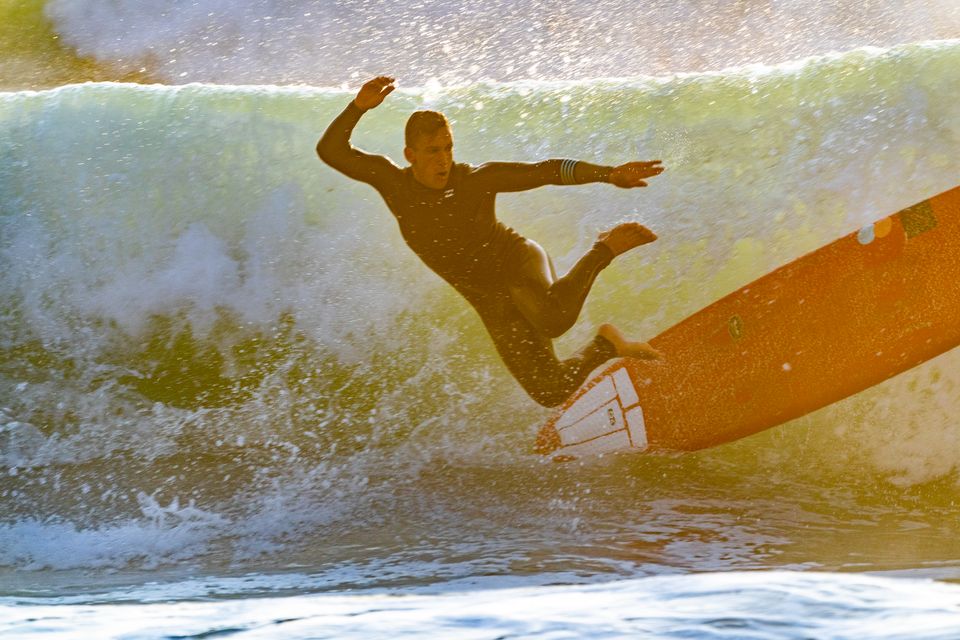
Every surfer falls. Beginners fall ten times more than experienced surfers, and shorebreak (waves breaking directly on or very close to the shore in shallow water) is the situation where bad falls turn into real injuries. The RNLI publishes annual statistics on shore-related cervical spine injuries, most of which come from one mistake: diving head-first into shallow water either off a board or from the shore. The injuries are catastrophic and almost entirely preventable.
Falling well is a learnable skill. Pro surfers fall hundreds of times a year on heavy reefs and walk away most of the time because they have drilled how to land flat, protect their head and surface controlled. This guide covers the core techniques for falling safely, the differences between sand, rock and reef bottoms, and why head protection matters more than almost anything else you learn in your first two years.
- Never dive head-first off the board; always fall feet-first or land flat on your back.
- Protect your head with your arms in the surface-recovery zone before lifting your face.
- Sand is forgiving but shorebreak in shallow water is the most dangerous beach scenario.
- Reef and rock bottoms require shoes, awareness of the bottom shape and a different fall posture.
The fall posture that prevents injury
When you wipe out, the goal is to land as flat and as wide as possible, in the deepest water you can reach. Diving head-first into the wave or off the front of the board concentrates the entire impact on the top of the skull and neck, which is exactly the geometry that causes cervical spine injuries. The right reflex is to fall sideways or backwards, arms slightly out for surface area, body flat and feet pointed away from the breaking wave.
Surf coaching in ISA and FF Surf curricula explicitly teaches the 'starfish' fall position: arms out, legs spread, body flat to maximize the deceleration over a larger surface. The starfish lands you in shallow water with much less impact than a streamlined dive, and it slows you before you hit the bottom. The instinct from swimming lessons (streamlined dive) is the wrong instinct in surfing.
- Fall sideways or backwards, never head-first.
- Land flat: starfish position with arms and legs spread.
- Aim for the deepest water you can; avoid landing in the trough.
- Pointed feet toward the wave, not the bottom.

The shorebreak danger zone
Shorebreak is the most dangerous beach scenario for both surfers and swimmers. Waves break directly on the sand in shallow water, often steeply, and the impact zone is exactly where someone tries to stand or paddle out. The NOAA and RNLI both flag heavy shorebreak as a leading cause of neck and shoulder injuries, especially among visitors who underestimate the energy of a wave breaking onto knee-deep water.
If you are caught by a shorebreak wave, the right response is to crouch low, turn sideways to the wave, and let it pass over you while you hold the bottom or stay low until it dissipates. Trying to outrun a breaking shorebreak wave by standing up rarely works and exposes the chest, head and shoulders to the heaviest part of the impact. Surf away from heavy shorebreaks as a beginner; choose beaches with a sandbank further offshore.

Protecting the head after the impact
The first second after a wipeout matters as much as the fall itself. The board is now somewhere in the whitewater, attached by the leash but bouncing in a direction you cannot predict. The cardinal rule is to cover the head with both arms (boxing-style) the moment you stop tumbling and before you push to the surface. The board can rocket back into the head from any angle, and a leash absorbs almost nothing of that impact.
Surface slowly and look up first. A second surfer paddling out might be directly above you. Pop up smoothly, retrieve the board hand-over-hand on the leash, and keep your head turned away from the breaking direction in case the next wave is right behind. Surfer Magazine and Surfline both publish wipeout-recovery sequences from professional surfers showing exactly this: arms up, surface carefully, look first.
- Cover the head with both arms before lifting your face.
- Surface carefully; another surfer may be above you.
- Retrieve the board hand-over-hand on the leash, never by yanking.
- Keep your head turned away from the breaking direction.
Reef and rock bottoms: a different fall
Sand forgives almost any fall posture. Reef and rock do not. On a reef break, the bottom is sharp coral, urchins or volcanic rock at depths sometimes under one meter even in head-high surf. The correct posture for a reef fall is to land on the back rather than the front (to protect the face), stay flat to spread the impact, and surface slowly with hands up to protect the head.
Reef booties, even thin 2 mm split-toe versions, protect from the cuts that turn every reef surf trip into an antibiotic story. Local schools in Indonesia, French Polynesia, the Maldives and parts of the Caribbean teach this as the baseline rule. On rocky points (Cornwall, parts of Spain, Brittany), the same logic applies for slightly different reasons: thin shoes plus a flat-fall posture.
- Reef booties protect from cuts and urchins year-round on coral and lava bottoms.
- Land on the back, not the front, to protect the face and chest.
- Stay flat; never tumble head-first.
- Have antiseptic and antibiotic ointment in the kit on reef trips.
Building the reflex through practice
Falling well is a reflex, not a thought process. The wave gives you maybe half a second between losing balance and impact, which is not enough time to remember a list of rules. Practice the starfish fall position in a calm pool, then in small whitewater, before you ever face heavy waves. Most certified surf schools include a falling drill in the first lesson; ask if yours does not.
Stretching, neck strength and basic breath-hold training also matter. A short neck stretch routine reduces the risk of whiplash on awkward landings. Two-breath-hold drills (holding breath calmly for 30 to 45 seconds in a pool) build the comfort needed to ride out a long hold-down without panic. Surfer Magazine and the ISA coach manuals both list these as practical injury prevention investments.
Before you go
- Practice the starfish fall position in flat or small whitewater before scaling up.
- Never dive head-first off the board or into a wave.
- Cover the head with both arms after every wipeout, before surfacing.
- Wear reef booties on coral, lava or rocky bottoms.
- Avoid heavy shorebreak as a beginner; pick beaches with offshore sandbanks.
FAQ
Should I wear a helmet for surfing?
For most beginner and intermediate beach-break surfing, no. Helmets are uncommon outside heavy reef and big-wave situations because they add drag, can shift on impact and reduce hearing. They are increasingly used by intermediate surfers in Pipeline-style heavy reef breaks and by surfers with prior head injuries. For a typical beach session, focus on fall technique and arm protection instead.
What do I do if I get caught by the next wave after a wipeout?
Get back to a fall posture: low body, head down, hands up to protect. Take a breath if you have time. The hold-down is uncomfortable but rarely longer than ten to fifteen seconds at beginner-friendly beach breaks. Relax and let the turbulence dissipate before swimming up. Panic increases oxygen burn and makes the hold-down feel longer than it is.
How do I avoid hitting my own board on a wipeout?
Cover the head with both arms immediately, surface slowly with hands first, look up before raising the face. The leash will tug on your ankle and tell you roughly where the board is. Reel it in hand-over-hand rather than yanking; a quick pull can snap the board back into your face. Avoid wipeouts directly under the board by falling sideways or backwards rather than off the front.
Use BeachFinder to check today's spot.
Use your location, search any city worldwide or explore the map to compare the 20 most relevant beaches and swimming spots around you.
Download BeachFinder
Find beach conditions, sea temperature, wind, UV, water quality, and nearby swimming spots before you go.
These beach pages connect the guide advice with real spot details: sea temperature, wind, UV index, waves, access and photos when available.
Praia de Quarteira
PT
Playa de la Mata Negra
PT
Praia do Carvalho
PT
Plage Rive Gauche
FR
Plage de la Dalle
FR
Plage de Saint-Jean
FR
Praia dos Alemães
PT
Praia da Barra
PT
Plage du Lividic
FR
Lagoa de Albufeira
PT
Plage de Notre-Dame
FR
David
FR
Plage du Moulin Brûlé
FR
Praia dos Castelos
PT
Plage de La Folie Calette
FR