
Surf etiquette and the unwritten rules of the lineup
Priority, dropping in, paddling out path, snaking, communication: the unwritten rules that decide whether a lineup welcomes or rejects you.

Surf etiquette is not a polite suggestion. It is the safety system that prevents collisions in crowded water, the social contract that decides who gets the next wave and the cultural code that separates a welcomed visitor from someone the locals will quietly freeze out. There is no global written rulebook, but the core principles are almost identical from Hossegor to Hawaii. They are taught implicitly in every certified surf school and explicitly in ISA coaching manuals.
The good news is that the rules are mostly common sense once explained. The bad news is that beginners regularly break them by accident, and the cost is sometimes a board to the head, sometimes a confrontation that ruins the session. This guide walks through priority, dropping in, paddling out, snaking and communication, with practical examples of what beginners get wrong and how to read the lineup before you make a mistake.
- The surfer closest to the peak (where the wave is breaking first) has priority on that wave.
- Dropping in (taking off in front of a surfer who already has priority) is the worst common offense.
- Paddle out around the lineup, not through it; never paddle through where someone is riding.
- Communication and eye contact prevent 90 percent of lineup conflicts before they start.
Priority: the closest surfer to the peak
The most important rule in surfing is simple: on any given wave, the surfer closest to the peak (the part of the wave that is breaking first) has the right of way. Everyone else must pull off, paddle over the back or wait for the next one. This is the foundation of every lineup from the Mediterranean to the North Shore. The closest-to-peak rule means the wave is yours from the moment you commit to paddling, not from the moment you stand up.
The peak shifts. On a beach break, it shifts session to session and even wave to wave. Reading where the next wave will break first is part of the skill. On a point break, the peak is consistent and the lineup is usually arranged so the surfer deepest (closest to the breaking section) takes the wave. On a reef break, the peak is fixed and rotation usually emerges naturally among regulars.
- Closest to the peak gets the wave on a beach break.
- Deepest surfer (furthest in toward the breaking section) gets the wave on a point or reef.
- If two surfers are equally placed, the one who has been waiting longer usually goes.
- Calling 'mine' or 'yours' clearly is acceptable and resolves most ambiguity.

Dropping in: the cardinal sin
Dropping in means taking off on a wave where another surfer is already up and riding with priority. It is the single most resented offense in surfing, partly because it ruins the other person's wave and partly because the collision risk is high. The Surfline beginner code, the ISA coach manual and every reputable surf school in France, Portugal, the UK and the US all teach beginners that priority is the first thing to learn, before pop-up technique.
Beginners drop in by accident more often than on purpose. The fix is to look both directions before committing to a wave, paddle hard but be ready to abort, and pull off the wave (drop to your knees or back to your stomach) the moment you see someone already up with priority. A clean abort is a sign of a respectful surfer; arguing your way through is a sign of a problem.
Paddling out without disrupting the lineup
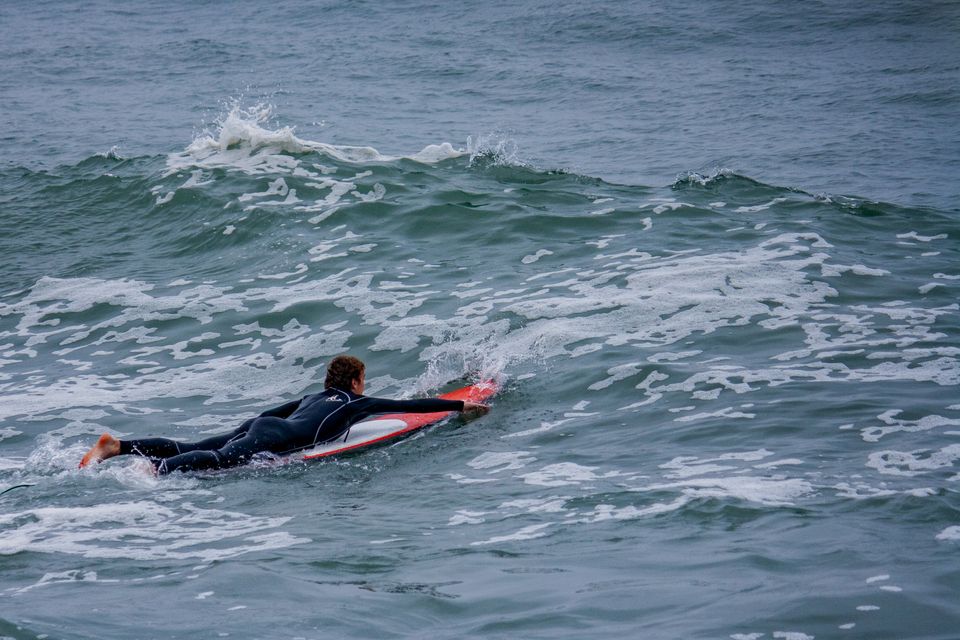
The path you take to the lineup matters. The rule is to paddle out around the breaking zone, not through it. On a beach break with a clear channel between sandbanks, use the channel. On a point break, paddle wide around the surfers riding and approach from the side, not down the line of the breaking wave. Paddling through the lineup forces riders to abort or risk collision, and it is the second most common offense after dropping in.
When you have no choice but to paddle near the breaking zone (small beach, no channel, sets pushing you back), the rule is to give right of way to the rider. That means paddling toward the whitewater or breaking section, not the open face. The rider goes for the shoulder; you cut behind toward where the wave has already broken. It is counterintuitive but safer and more respectful.
- Use channels and edges of the breaking zone whenever possible.
- Never paddle in front of a rider on the open face.
- When in doubt, paddle toward the broken whitewater section.
- Watch the set rhythm and time your paddle out between waves.
Snaking, hassling and the rotation
Snaking is paddling around a surfer who is already deeper and claiming priority by getting closer to the peak at the last second. It is technically legal under the closest-to-peak rule but socially aggressive and a major source of lineup friction. Hassling is sitting too close to a surfer who is waiting, forcing them to either defend their position or move. Neither is illegal but both are reasons locals will start to ignore visiting surfers.
Most established lineups operate on a soft rotation: surfers wait their turn, give space, and accept that everyone eventually gets a wave. Aggressively chasing every peak burns goodwill fast. The visitors who get the warmest reception are the ones who watch for ten minutes, sit slightly inside or wider than the main pack, take obvious unclaimed waves and stay relaxed during the inevitable busy sets.
- Wait your turn; do not chase every wave.
- Sit slightly wider or inside the main pack until you read the rotation.
- Smile, nod, say hello; locals notice quickly.
- Avoid paddling around someone who is clearly already in position.
Communication, eye contact and the unwritten respect
A surprising amount of lineup management is done with eye contact and small calls. Two surfers in similar position can settle priority in two seconds by looking at each other and one saying 'go' or 'yours'. A surfer paddling for a wave with another nearby can call 'left' or 'right' to declare direction. None of this is in any rulebook; all of it prevents collisions.
Respect is also shown by the small habits. Apologizing immediately when you make a mistake, helping someone retrieve a board after a wipeout, not snaking the visitor on their second day, not yelling at someone obviously still learning. Every coastal community has stories of crowded lineups where one rude visitor sets the tone for a session; do not be that visitor. Use BeachFinder to find quieter beach options when the famous peak is crowded.
Before you go
- Learn the closest-to-peak rule and apply it before standing up.
- Never drop in; abort immediately if you do by accident.
- Paddle out around the breaking zone, not through it.
- Use eye contact and short calls to communicate priority.
- Watch the rotation for ten minutes before claiming waves at a new spot.
FAQ
What do I do if I drop in on someone by accident?
Kick out of the wave immediately by dropping back onto your stomach or jumping off the board behind the breaking section. Apologize directly when you paddle back out. Most lineups will forgive an obvious accident, especially from a clearly newer surfer. Apologizing matters more than the drop-in itself; ignoring the mistake is what causes lasting tension.
Can two surfers share the same wave?
Sometimes, but only with explicit agreement. On a long peeling wave where one surfer goes left and the other goes right from the same peak, sharing is fine. On a wave where both are going the same direction, the priority rule applies and only one surfer rides. Party waves between friends are different and usually arranged in advance.
Should I surf a crowded famous spot as a beginner?
Usually no. Famous lineups (Hossegor La Graviere, Supertubos, Pipeline) are crowded, fast and often heavy, and beginners create real safety risks among advanced surfers. Use BeachFinder to find quieter beach breaks nearby with similar exposure but lighter crowds. You will catch more waves, take fewer beatings and progress faster.
Use BeachFinder to check today's spot.
Use your location, search any city worldwide or explore the map to compare the 20 most relevant beaches and swimming spots around you.
Download BeachFinder
Find beach conditions, sea temperature, wind, UV, water quality, and nearby swimming spots before you go.
These beach pages connect the guide advice with real spot details: sea temperature, wind, UV index, waves, access and photos when available.
Praia de Quarteira
PT
Playa de la Mata Negra
PT
Praia do Carvalho
PT
Plage Rive Gauche
FR
Plage de la Dalle
FR
Plage de Saint-Jean
FR
Praia dos Alemães
PT
Praia da Barra
PT
Plage du Lividic
FR
Lagoa de Albufeira
PT
Plage de Notre-Dame
FR
David
FR
Plage du Moulin Brûlé
FR
Praia dos Castelos
PT
Plage de La Folie Calette
FR