
How to compare beginner surf schools by region
Group size, water-time per hour, qualified instructors, kit included and red flags to look for before booking a beginner surf lesson.
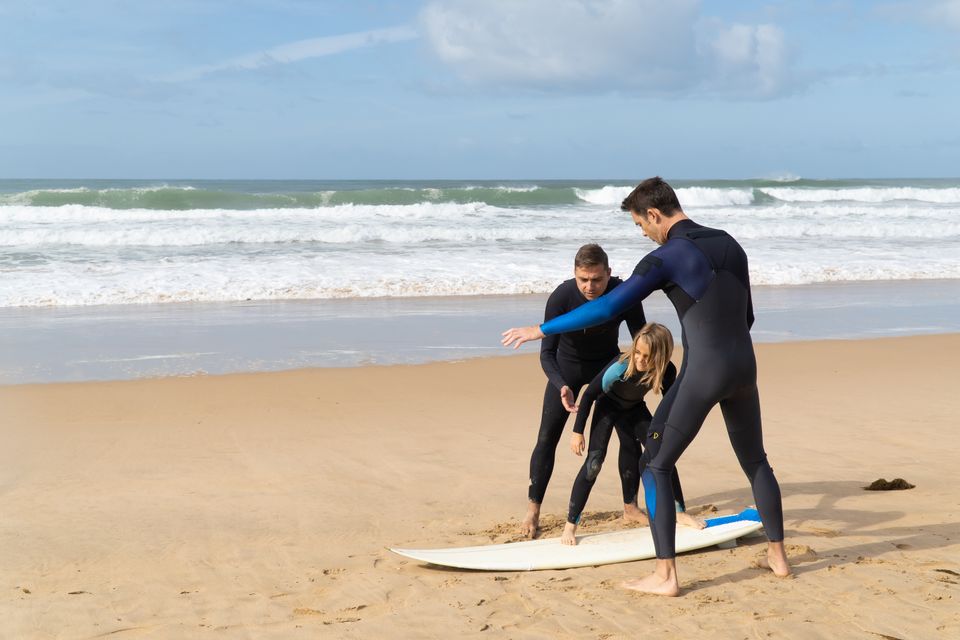
Surf schools rarely advertise the things that matter most. Pretty boards, branded vans and a beach photo say very little about whether you will actually stand up by the end of the week. The useful comparison is closer to a small audit: who is teaching, how many students are in the water at once, how long you spend on a wave and what happens when conditions change.
Beginner sessions are the moment when a region is at its strongest or weakest. A good school in Hossegor or Newquay turns a forgiving sandbank into a productive morning. A bad school in the same town turns the same beach into ninety minutes of standing in waist-deep whitewater. Treat the school as part of the beach, not a separate booking.
- Group size and student-to-instructor ratio decide your real water-time per hour.
- Qualified instructors are usually federation-certified (FFSurf in France, ISA-equivalent elsewhere) and lifeguard-trained.
- Included kit should cover board, wetsuit and ideally insurance, with a clear backup plan for bad surf days.
- Red flags include vague pricing, no insurance, no rotation between instructor and assistant, and a single beach with no plan B.
Start with the ratio, not the price
The most common mistake is comparing prices on the homepage. A 35 EUR group lesson with twelve students and one instructor is rarely better value than a 55 EUR session with six students and two instructors. The first burns your morning waiting in line. The second gets you on more waves and gives the instructor a chance to actually correct your stance.
Ask the school directly: how many students are in the water at the same time, how many instructors and assistants are active, and what happens when a class is full. A school that hesitates to answer is telling you something important. The good ones publish ratios because they are part of their pitch.
- Reasonable beginner ratio: one instructor for six to eight students, plus an assistant in the water.
- A second person on the beach to push beginners into the wave is a strong signal.
- Avoid lessons where the instructor stays on shore the entire time during the first session.
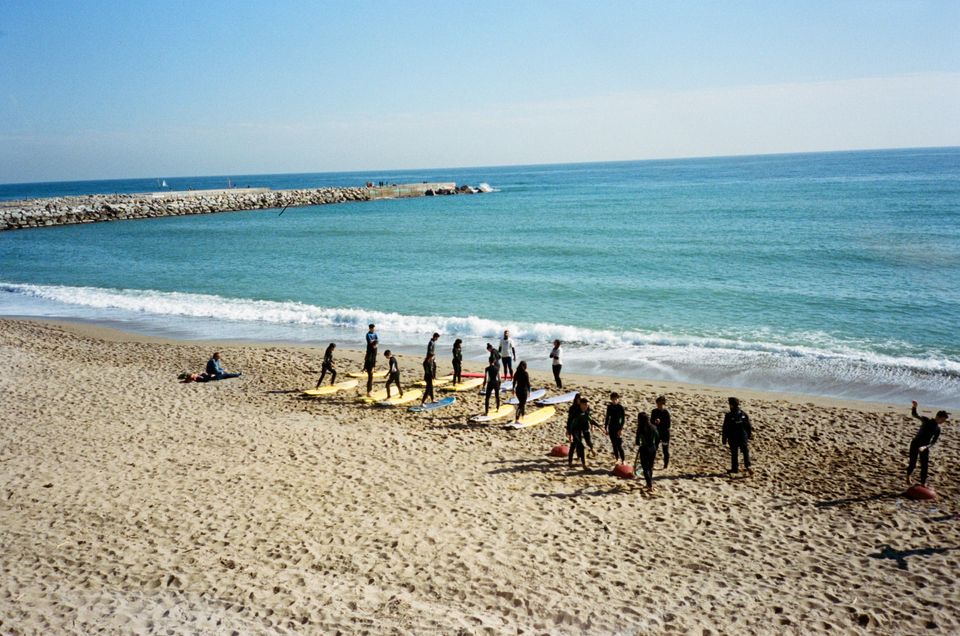
Water-time matters more than total session length
A 'two-hour lesson' can mean ninety minutes of useful surfing or thirty minutes of changing, briefing, walking and waiting. Beginner progress is roughly proportional to wave count, so the question is how many waves you actually catch in that window.
Schools with a short land briefing, an organized rotation and instructors close to the breaking zone usually deliver more waves per hour. Some publish a target wave count. Others will tell you over the phone if you ask. A vague answer often means the lesson is mostly group choreography.
Check certification, insurance and the safety chain
In France, beginner lessons should be run by instructors holding a federation diploma (BPJEPS or moniteur federal FFSurf). In the UK, look for ISA Level 1 or 2 plus a beach lifeguard qualification (RLSS or SLSGB). In Portugal, surf schools must be registered with the federation (FPS) and the captaincy. In the US, ISA, NSSIA or county lifeguard certifications are common signals.
Insurance is not glamorous, but it is the difference between a sprained ankle and a paperwork disaster on holiday. Reputable schools include third-party liability and accident cover in their price, and they will tell you which policy applies if you ask.
- Look for federation logos on the door, not just on the website.
- Ask about lifeguard cover on the teaching beach, especially outside July and August.
- If the school cannot explain what happens if someone gets injured, that is a red flag.
What should be included in the price
A serious beginner package usually includes the surfboard, the wetsuit, a leash, often a rashguard and the instructor. Some schools add insurance and a free repeat session if surf conditions are unsafe. Watch for surcharges on bigger boards, hooded wetsuits in cold seasons or shower access at the school base.
Multi-day camps should describe what happens if the swell goes flat or becomes too big. The good ones will move the lesson to a more sheltered beach in the same coastal cluster, run a theory session or refund the day cleanly. Vague 'weather policy' wording is a warning.
- Confirm whether wetsuits include hood and booties for cold-water seasons.
- Check whether insurance is included or sold separately at extra cost.
- Ask what the backup beach is when the main spot is too big or too crowded.
Red flags that show up before you book
Some warning signs are visible before you even pay. A school that only operates from one beach with no fallback plan is at the mercy of a single forecast. A school that pushes you toward 'private' lessons that turn out to be groups of four is misrepresenting its product. A school that refuses to share instructor names or qualifications is hiding something.
Use BeachFinder to confirm what the teaching beach actually looks like: sandbank or reef, exposed or sheltered, parking realistic, lifeguard supervised in season. A surf school cannot fix a beach that is the wrong choice for the day, but a good school will already have moved you somewhere else.
Reviews are useful but read them with skepticism. A school with hundreds of five-star reviews and a noticeable cluster of one-star complaints about overcrowded lessons or refused refunds is probably running two products: the marketed one and the real one. Look for reviews that describe specific instructors, ratios and rotations rather than vague enthusiasm.
- No instructor names or photos on the website.
- Group sizes that change after booking.
- No clear policy on bad weather, refunds or rescheduling.
- A single fixed beach with no alternative when surf is too strong.
- Reviews mention crowding, no-shows or pushed upgrades repeatedly.
Before you go
- Confirm the student-to-instructor ratio in writing before booking.
- Ask about water-time per session and how rotation works.
- Verify federation certification and lifeguard cover at the teaching beach.
- Check that wetsuit, board and insurance are included for the season.
- Compare the teaching beach with one nearby backup spot in BeachFinder.
FAQ
How many students per instructor is reasonable for beginners?
A common standard for federation-certified schools is one instructor for six to eight beginners, often with a second person assisting in the water. Anything above ten students per instructor usually means more waiting and less coaching, especially for first-time surfers who need a hand getting into the wave.
Are private surf lessons worth the extra cost?
Private lessons are worth it when you have a specific weakness, when conditions are crowded or when you only have one short window in your trip. For a true first session, a small group with two instructors is often enough and can feel less intense. Confirm exactly how many people 'private' actually means before paying the upgrade.
What happens if the surf is too big on my booked day?
Reputable schools move the lesson to a more sheltered beach in the same coastal cluster, run a theory and ocean-safety session, or reschedule for a calmer day. Schools that simply cancel without offering an alternative or a refund are not investing in the safety chain. Always read the weather and refund policy before paying.
Use BeachFinder to check today's spot.
Use your location, search any city worldwide or explore the map to compare the 20 most relevant beaches and swimming spots around you.
Download BeachFinder
Find beach conditions, sea temperature, wind, UV, water quality, and nearby swimming spots before you go.
These beach pages connect the guide advice with real spot details: sea temperature, wind, UV index, waves, access and photos when available.
Praia de Quarteira
PT
Playa de la Mata Negra
PT
Praia do Carvalho
PT
Plage Rive Gauche
FR
Plage de la Dalle
FR
Plage de Saint-Jean
FR
Praia dos Alemães
PT
Praia da Barra
PT
Plage du Lividic
FR
Lagoa de Albufeira
PT
Plage de Notre-Dame
FR
David
FR
Plage du Moulin Brûlé
FR
Praia dos Castelos
PT
Plage de La Folie Calette
FR