
How to choose bodyboarding spots in Portugal and Spain
Close beach breaks, board wax, fin types and how to read Iberian beaches for a productive bodyboard session.

Bodyboarding is often described as the easier cousin of surfing. That undersells what the sport actually does well: it works on closer, steeper, faster-breaking waves than a shortboard, lets you ride hollow sections that most surfers cannot reach, and gets you onto a wave with much less paddle time. Portugal and Spain are arguably the best European stretch for bodyboarders because the Atlantic delivers exactly the kind of punchy, shallow beach break that the discipline is designed for.
But not every wave is a bodyboard wave. Some beaches that look fun for a surfer are dangerous closeouts on a bodyboard. Some that look soft on the surf cam are perfect for sponger sessions. This guide walks through what makes a beach right for bodyboarding, where to find them along the Iberian coast, how to wax and rig a board correctly, what fins to choose and how to plan a session that does not end with rashes and broken leashes.
- Bodyboarding loves shallow, hollow, fast-breaking beach breaks that often punish shortboards.
- Portugal's west coast (Ericeira, Nazare south beaches) and Spain's Cantabrian coast deliver the most reliable Iberian bodyboard windows.
- Wax the deck and rails, choose stiff symmetric fins, and check the leash plug before every session.
- Currents around piers, river mouths and rip channels are the main hazard; read the beach before paddling out.
What makes a wave a bodyboard wave
A bodyboard wave breaks faster and steeper than a typical surf wave. The board is short, finless and prone, so it accelerates down the wave face naturally without the long paddle of a shortboard. That means hollow shoulder-high to overhead waves that close out for a shortboarder can be perfect drops for a bodyboard. The reverse is also true: long, slow, mushy waves that surfers love are uninspiring on a sponger.
Bodyboard waves also tend to break closer to shore. Beach breaks with shifting sandbars, shorebreak slabs, and waves that peel into a final hollow inside section are the bread and butter. Reef breaks can work too, but only on the smaller end and with respect for the rocks. The discipline of bodyboarding evolved precisely because some of these waves were essentially unsurfable on anything else.
- Steep, hollow drops with a defined lip are the signature.
- Shallow beach breaks and inside slab sections deliver reliable bodyboard waves.
- Mushy long-period waves are usually wasted on a bodyboard.

Where to bodyboard along the Iberian coast
Portugal's west coast is the European bodyboard capital. Ericeira (Praia da Empa, Sao Lourenco) holds bodyboard sessions almost year-round, with both world-tour level reef waves and accessible beach breaks for intermediates. Nazare's smaller south-facing beaches deliver clean bodyboard waves when the main canyon is too big. Around Peniche, Supertubos and Cantinho da Baia are bodyboard staples. Further south, the Costa Vicentina (Arrifana, Bordeira, Carrapateira) catches almost every Atlantic swell.
On the Spanish side, the Cantabrian coast (north Spain, from Galicia to the Basque country) delivers bodyboard windows from autumn through spring, with hollow beach breaks like El Brusco, Sopelana and Mundaka's inside section on small days. The Canary Islands (Fuerteventura's North Shore, Lanzarote's El Quemao, Gran Canaria's La Cicer) are bodyboard playgrounds with year-round warm-water swells. Cadiz province in the south offers gentler beach breaks for learners (El Palmar, Conil) but lacks the punch of the Atlantic.
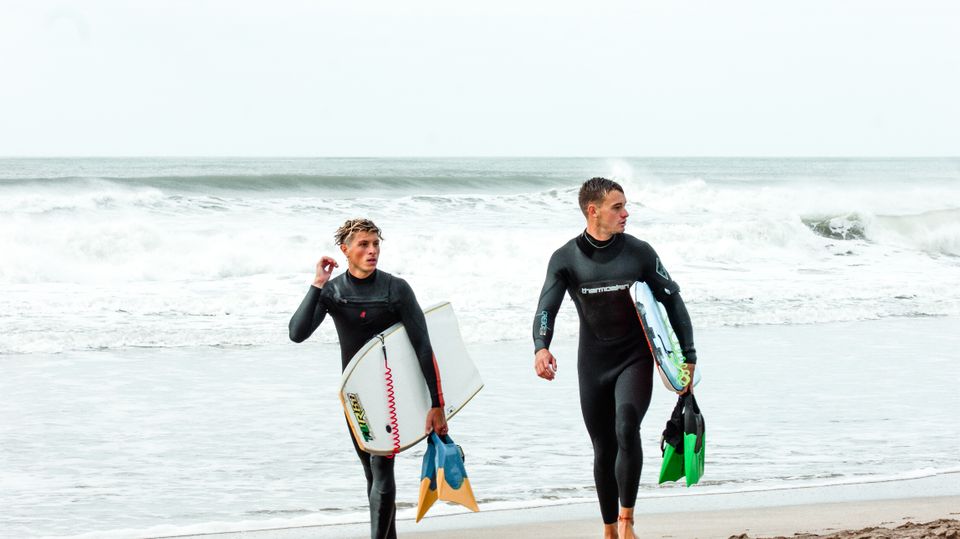
Board, wax and rigging basics
Bodyboard wax is applied to the deck (top surface, where your hands and elbows grip) and to the rails (edges, for grip when carving). The goal is friction, not coverage; you want a textured surface that holds even when wet, not a thick smear. Sex Wax, Sticky Bumps and Mr. Zogs all sell cold-water and warm-water variants. Cold-water wax is softer and adheres better below 18 C; tropical wax stays grippy at higher temperatures.
Check the leash plug and the leash itself before every session. The classic bodyboard leash attaches to the wrist or the bicep, not the ankle (unlike surf leashes). The plug is the weakest point on a bodyboard; a worn plug or frayed leash means a lost board on the wrong wave. Bring a spare leash on any travel trip. Replacement plugs are easy to buy in any Iberian surf shop.
- Apply wax to deck (under hands and chest) and rails (along edges).
- Use cold-water wax below 18 C, warm-water wax above 22 C.
- Check leash plug, plug screw and leash string before every session.
- Carry a spare leash on travel; surf shops sell replacements everywhere on the Iberian coast.
Choosing fins for power, comfort and currents
Bodyboard fins are short, stiff swim fins designed for kicking through breaking waves and accelerating into a drop. The classic choices are stiff symmetric fins (Churchill Makapuu, Viper Delta) for power, or softer asymmetric fins (Hubboards Air Hubb) for comfort on long sessions. Brand matters less than fit. A fin that hurts after twenty minutes will end your session early, regardless of how powerful it is.
Fin socks (neoprene booties worn under fins) prevent the chafing that ruins long sessions. They also add a layer of warmth in cold water and protection against urchins and rocks on Cantabrian and Galician reefs. Fin leashes (small tethers attaching fins to the ankle) prevent the heartbreak of losing a fin in a wipeout; cheap and worth the gram.
- Symmetric stiff fins (Churchill, Viper Delta) for power.
- Asymmetric softer fins (Hubboards) for long sessions and comfort.
- Neoprene fin socks to prevent chafing and keep feet warm.
- Fin leashes are cheap insurance against losing a fin mid-session.
Hazards on Iberian bodyboard beaches
Bodyboard beaches in Portugal and Spain are often the same beaches that give shortboarders nightmares: shallow, fast-breaking, close to rocks. Currents around river mouths (Mondego, Douro, Mino) drop significant freshwater outflow and create wide rip channels. Cliffed-out beaches (parts of Costa Vicentina, Galicia) have currents that funnel along the rocks rather than out to sea, which can make a wipeout into a rocky scrape.
Read the beach before paddling out. Look for water that is darker or moving faster than the rest, which usually marks a rip channel. Spend ten minutes watching where surfers and other bodyboarders sit, where they paddle out and where they get pushed. If a lifeguard tower is on duty, walk over and ask. Portuguese and Spanish beach lifeguards (Bombeiros, Cruz Roja) are usually helpful and speak basic English on tourist beaches.
- Watch for rip channels (darker, faster water) before paddling out.
- Avoid bodyboarding alone on remote cliff-backed beaches.
- Ask the lifeguard about local hazards if a tower is in service.
- Respect surf etiquette: bodyboards do not have priority over shortboards on shared peaks.
Before you go
- Pick a beach break with hollow, fast-breaking waves rather than slow mush.
- Wax the deck and rails with the right temperature wax before paddling out.
- Check leash, plug and fins before every session.
- Wear neoprene fin socks and a leash tether to prevent gear loss.
- Watch the beach for ten minutes before paddling; locate rip channels.
FAQ
Is bodyboarding easier than surfing?
The first wave is easier on a bodyboard because you ride prone and the board catches waves with much less paddle than a shortboard. Reaching intermediate level (drops, turns, basic tricks) also tends to be faster. Advanced bodyboarding (DK, inverts, big shorebreak) is its own discipline that requires serious commitment and fitness. So 'easier to start, hard to master', much like surfing itself.
What size bodyboard should I buy?
Stand the board next to you: the top should reach roughly to your belly button or just below. Heavier riders need slightly longer boards (42 to 45 inches) for buoyancy. Lighter riders go for 39 to 41 inches. Travel boards (semi-stringerless or with a flexible stringer) are more forgiving but slower than performance boards. For a first board, mid-range models from Morey, Hubboards or Pride are reliable.
Can I bodyboard without fins?
On small mushy waves close to shore, yes, you can catch waves by pushing off the bottom. Anything bigger or steeper requires fins for the kicks needed to paddle into the wave and out through breaking surf. Fins are also a safety tool: they let you swim against current or out of a rip. Bodyboarding without fins above waist-high surf is not recommended.
Use BeachFinder to check today's spot.
Use your location, search any city worldwide or explore the map to compare the 20 most relevant beaches and swimming spots around you.
Download BeachFinder
Find beach conditions, sea temperature, wind, UV, water quality, and nearby swimming spots before you go.
These beach pages connect the guide advice with real spot details: sea temperature, wind, UV index, waves, access and photos when available.
Praia de Quarteira
PT
Playa de la Mata Negra
PT
Praia do Carvalho
PT
Praia dos Alemães
PT
Praia da Barra
PT
Lagoa de Albufeira
PT
Praia dos Castelos
PT
Praia da Galé (leste)
PT
Praia de Odeceixe-Mar
PT
Praia da Adraga
PT
Praia da Entrada da Barca
PT
Praia da Baforeira
PT
Praia das Adegas
PT
Praia do Castelo
PT
Praia da Rocha
PT