Sardinia vs Corsica: best beaches, sand color, accessibility and prices
Sardinia and Corsica share a strait but feel different. Sand color, beach accessibility, water clarity and prices compared with concrete examples.

Sardinia and Corsica share the Strait of Bonifacio and a similar sea, but as beach destinations they behave quite differently. Sardinia is Italian, larger, with the famous Costa Smeralda in the north and the long pale beaches of the south and west. Corsica is French, mountainous, with steep terrain falling fast to the coast, dramatic granite headlands and a more concentrated set of beach destinations.
Use this guide to decide which of the two large western Mediterranean islands fits your trip. Sand color is genuinely different on average. Driving distances are larger in Sardinia and tighter in Corsica. Prices differ in both directions depending on where you land. And the access patterns to the best beaches diverge: Sardinia has more spread-out, easy-access sand, while Corsica concentrates spectacle into smaller coves that often require a walk.
- Sardinia: paler sand on average, larger beaches, easier accessibility, classic Italian polish.
- Corsica: steeper terrain, more granite coves, frequent walks to the best beaches, French mountain-island feel.
- Both deliver clear water; Bonifacio Strait and northern Sardinia rank among the clearest in Europe.
- Costa Smeralda is the priciest pocket in either island; mid-Sardinia south is the better value.
Sand color: not just marketing
Sardinia is known for pale, almost white sand and the most famous examples deliver it. La Pelosa near Stintino, Cala Brandinchi on the east coast, Spiaggia di Tuerredda in the south and the long beaches of the Costa Verde rank among the palest sand in Europe. The chemistry varies (quartz, calcareous algae, fragmented shell) but the visual impact is consistent.
Corsica has a wider sand palette. Plage de Palombaggia and Plage de Santa Giulia near Porto-Vecchio deliver pale sand and turquoise water comparable to Sardinian benchmarks. Plage de Saleccia and the Desert des Agriates beaches are similarly pale. But the rest of the island runs through golden, then darker grey-pink granite sand, especially as you move north along the western coast around Calvi and the Balagne. Corsica is more varied; Sardinia is more uniform.
- Sardinia headlines: La Pelosa, Cala Brandinchi, Tuerredda, Costa Verde — pale sand, turquoise water.
- Corsica headlines: Palombaggia, Santa Giulia, Saleccia, Agriates — pale sand pockets.
- Corsica also has golden and pink granite sand on the western coast around Calvi.
- Sardinia delivers more uniform pale sand across multiple coasts.
Accessibility: drive in vs walk in
Sardinia is a large island with a road network that puts most famous beaches within a short drive of a coastal road. La Pelosa, Tuerredda, Chia, Cala Goloritze (one notable walk-in exception) and the Cagliari city beaches are reached easily by car. The downside is the distances: Cagliari to Costa Smeralda is around 280 kilometers of varied road and not a casual day trip.
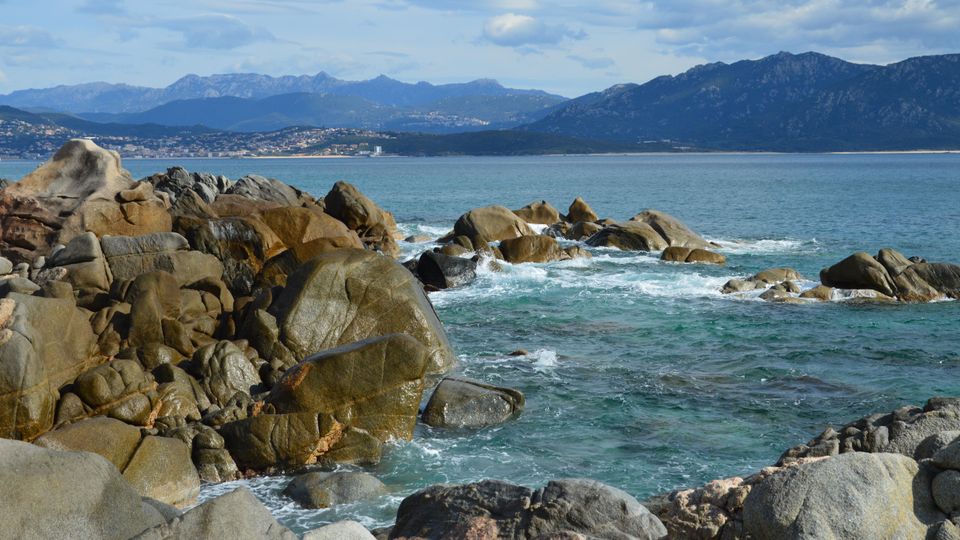
Corsica has a smaller surface but a more mountainous interior. Many famous beaches require walking from the nearest road or boat access. Plage de Saleccia is a 12-kilometer 4x4 track or a long hike or a boat from Saint-Florent. Roccapina requires a steep descent. Even Palombaggia involves narrow roads in summer traffic. Spectacle is rewarded with effort.
Prices: where each island runs cheap and where it doesn't
Costa Smeralda in northern Sardinia is the priciest pocket in either island. Porto Cervo, Porto Rotondo and the surrounding villages run on yacht-economy prices with hotel doubles starting at 300 to 500 euros in summer and restaurants matching. Olbia and the rest of the north stay reasonable. Southern Sardinia (Cagliari, Chia, Pula) and central-west (Oristano, Costa Verde) deliver mid-tier Italian beach holiday prices, typically 120 to 200 euros for a summer double.
Corsica runs more uniformly mid-tier with peaks. Porto-Vecchio, Bonifacio and Calvi command Riviera-adjacent prices in July and August, with doubles 200 to 400 euros for decent rooms. Central Corsica, Cap Corse and inland villages stay closer to 100 to 180 euros. Ferry costs (Marseille-Bastia, Toulon-Ajaccio, Nice-Calvi or Livorno-Bastia) add a meaningful chunk to a Corsica budget, while Sardinia ferries from mainland Italy can be reasonable on overnight runs.
- Sardinia Costa Smeralda summer double: 300-500+ euros, premium pocket.
- Sardinia south and west summer double: 120-200 euros, mid-tier.
- Corsica Porto-Vecchio and Bonifacio summer double: 200-400 euros.
- Corsica Cap Corse and inland summer double: 100-180 euros.
Water clarity and snorkeling
Both islands rank among the clearest in the Mediterranean. The Bonifacio Strait between them, with the Lavezzi islands on the Corsican side and the Maddalena archipelago on the Sardinian side, delivers some of the clearest water in Europe. Copernicus data confirms low turbidity and the European Environment Agency rates bathing water in both regions consistently excellent. Snorkeling is rewarding throughout, with concentrations of marine life near rocky headlands.
Sardinia has more easily accessible clear water from beach entries, especially in the north and east. Cala Goloritze, Cala Mariolu and the Gulf of Orosei beaches deliver Caribbean-style turquoise but require boat access from Cala Gonone. The Costa Smeralda is famously photogenic for water clarity. Corsica matches it from the Lavezzi islands and from Saleccia, with the dramatic Calanques de Piana on the west coast adding scale to the experience.
When to pick which
Choose Sardinia for: easier drive-in beach access, more uniform pale sand, classic Italian food and polish, larger total surface to explore, generally cheaper outside Costa Smeralda. Best for families who do not want long walks to swim, for travelers who like a large island road trip, and for honeymoon stays at the polished end if budget allows.
Choose Corsica for: drama, mountain-and-sea combinations, smaller coves that reward walking, French and Corsican food, granite landscapes that no Mediterranean island matches. Best for active travelers who want to combine hiking (the GR20) with swimming, for couples who prefer concentrated beauty over breadth, and for travelers who value the French shoulder-season feel.
Before you go
- Decide by accessibility: drive-in (Sardinia) vs walk-in and boat-in (Corsica).
- Avoid Costa Smeralda in July and August unless you accept yacht-economy prices.
- Book Sardinia or Corsica ferries 4+ months ahead for July and August.
- Plan boat trips to Lavezzi (Corsica side) or Maddalena (Sardinia side) for the clearest water.
- Carry water shoes for Corsican granite shores and Sardinian rocky entries.
FAQ
Which has whiter sand, Sardinia or Corsica?
Sardinia, on average. La Pelosa near Stintino, Cala Brandinchi, Tuerredda and the Costa Verde beaches deliver consistent pale sand backed by turquoise water that ranks among the palest in Europe. Corsica has comparable pockets at Palombaggia, Santa Giulia and Saleccia but also has golden sand and pink granite shores along the western coast that produce a different aesthetic. Both islands are spectacular; Sardinia is the more uniform answer for travelers chasing pale-sand-and-turquoise photographs.
Is Corsica more expensive than Sardinia?
It depends on where you compare. Costa Smeralda in northern Sardinia is the priciest pocket in either island and is in a different bracket entirely. Outside that pocket, Sardinia generally runs cheaper for accommodation and food, especially in the south and central-west. Corsica is more uniformly mid-tier with premium pockets at Porto-Vecchio, Bonifacio and Calvi. Ferry costs to Corsica from mainland France can also add meaningfully to a Corsica budget; Sardinia overnight ferries from Italy are often more reasonable.
Which is better for a beach holiday with kids?
Sardinia, in most cases. The combination of drive-in beach access, calmer water in sheltered bays and shorter walks from car to sand suits family logistics. Chia, Costa Rei, Cala Brandinchi and the Cagliari beaches deliver classic family days. Corsica is wonderful for families with older kids who can handle a hike to Saleccia or a boat to Lavezzi, but the access patterns can be tiring with younger children. Both islands have lifeguarded resort beaches; Sardinia simply has more of them within easy walking distance of parking.
Use BeachFinder to check today's spot.
Use your location, search any city worldwide or explore the map to compare the 20 most relevant beaches and swimming spots around you.
Download BeachFinder
Find beach conditions, sea temperature, wind, UV, water quality, and nearby swimming spots before you go.
These beach pages connect the guide advice with real spot details: sea temperature, wind, UV index, waves, access and photos when available.
Plage Gazagnaire
IT
Plage Rive Gauche
FR
Plage de la Dalle
FR
Plage de Saint-Jean
FR
Plage du Lividic
FR
Plage de Notre-Dame
FR
Plage du Moulin Brûlé
FR
Plage de La Folie Calette
FR
Plage du Tertre Pelé
FR
Plage des Célestins
FR
Plage de Mousterlin
FR
Plage de Porsmeur
FR
Plage de la Phibie
FR
Plage du Fontanil
FR
Plage Gallice
IT
Hotels and rentals near Sardinia
Compare accommodation around this beach after checking current swimming conditions and local access. Prices and availability come from the accommodation partner.