Where to learn kitesurfing in Europe as a beginner
Wind reliability, shallow water lagoons, family-friendly schools and what makes a good first kitesurf spot.
Learning to kitesurf is faster and safer than most people expect, but only on the right beach with the right school. A flat shallow lagoon with side-onshore wind, a federation-certified school and a beach long enough to walk a tangled kite back is the difference between a fun ten-day camp and an early holiday in the emergency room. Europe has several spots that tick those boxes, and several that do not despite their reputation.
This guide walks through the conditions that matter for a first kite week, the European spots that consistently deliver them, what to look for in a school and how to plan a trip with kids or a non-kiting partner. The good news is that the best learning spots are almost always also pleasant family beaches with parking, food and shade, because the conditions that make them safe for beginners also make them comfortable for everyone else.
- Flat shallow water is the single most important condition for learning kitesurfing safely.
- Side-onshore wind is the school standard; offshore wind is dangerous for beginners.
- Federation-certified schools (IKO, VDWS, FFV) include rescue boat, kit and insurance.
- Family-friendly kite spots usually have parking, shade and supervised swim areas nearby.
What 'beginner-friendly' actually means
A kitesurfing beginner needs three things from the water: shallow depth (waist to chest), flat surface (no breaking waves) and a wind direction that pushes you back toward the beach if you lose control. Those three together give the student time to learn body drag, water start and basic kite control without getting flushed downwind or held under by waves.
Standard side-onshore wind blows along the beach at a slight angle, just enough to bring a drifting student back to shore. Pure onshore wind pins you against the beach and rocks. Pure offshore wind pushes you out to open sea, which is the single most dangerous configuration for a learner. Federation schools refuse to teach in offshore wind regardless of customer pressure.
- Waist to chest shallow water (3 to 5 km of consistent depth is ideal).
- Flat, non-breaking surface or small chop, never large waves.
- Side-onshore wind, never offshore, never pure onshore in heavy gusts.

European spots that deliver consistently
The lagoons of southwest Sardinia (Punta Trettu) are widely cited as the best beginner kitesurf training ground in Europe: knee-deep flat water for kilometers, reliable Mistral and thermal afternoon wind, and several federation-certified schools sharing a single beach. The Etang de Leucate and Etang de La Palme in Roussillon offer similar lagoon conditions with Tramontana wind, plus a working town just behind the beach.
El Gouna and the Egyptian Red Sea (technically Mediterranean-adjacent) are a year-round option for cold-season learners. In Spain, Tarifa is the most famous kite spot but is intermediate-level on most days; Los Lances south is the school zone. The Greek island of Naxos, in particular Mikri Vigla, has flat water and reliable Meltemi but the south wind day requires a different launch. In the Netherlands, the Brouwersdam offers good lagoon conditions for North Sea learners willing to wear thicker rubber.

What to ask a kitesurf school before booking
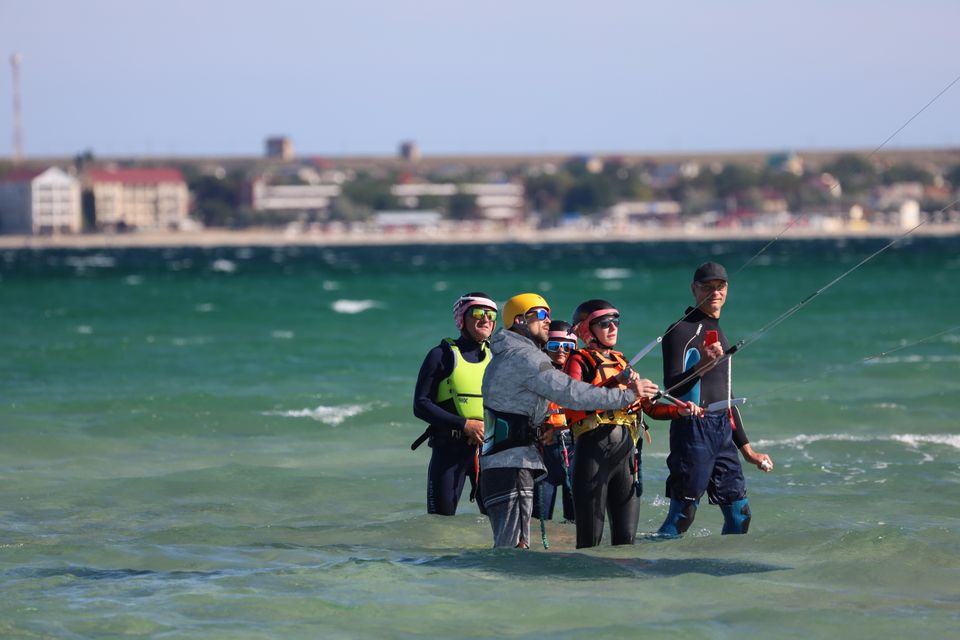
A federation-certified school (IKO, VDWS or FFV in France) follows a structured progression with rescue boat support, radio-equipped instructors and a clear insurance policy. Group size on the water rarely exceeds two students per instructor for full kite-control phases. Cheaper schools without certification sometimes save money by skipping the rescue boat, which is a serious safety gap on a windy day.
Ask directly: what is the ratio of students to instructors, is there a rescue boat on standby, what kit is included, what is the bad-weather plan and what is the refund policy if wind does not show up. A school that hesitates to answer these questions in writing is telling you something important. Established schools publish their policies on the booking page.
- IKO, VDWS or FFV certification is the minimum standard.
- Rescue boat on standby during all sessions.
- Ratio of one or two students per instructor maximum.
- Bad-weather plan: theory, alternative beach or rescheduling.
Kid-friendly logistics around the kite session
A common family scenario is one parent learning to kite while the other manages kids and a non-kiting partner. The good lagoon spots usually solve this because the lagoon is also a safe swim area for kids, with shallow water and gentle current. Punta Trettu and Leucate both have parking, beach restaurants and supervised swim areas that allow a 3-hour kite session to coexist with a family beach day.
Confirm that the kite zone and the swim zone are physically separated. Most established beaches enforce a buoyed corridor for kite traffic, with the family beach 100 to 300 meters away. If the school operates from a beach without that separation, expect tension and probably some restrictions on which days the kite zone is open.
- Look for spots with separated kite and swim zones (buoyed corridor).
- Confirm parking, shade and food options for the non-kiting partner.
- Check whether the school has a kids' watersports option (paddleboard, baby surf).
Planning a learning trip that actually works
A 7 to 10 day trip is the realistic minimum to reach independent riding. A weekend rarely produces more than basic kite control without water start. Plan for at least 5 days of lessons spread across the trip, leaving rest days and weather contingency. Late spring (May, June) and early autumn (September) offer warm water, reliable wind and lower crowds at most European spots.
Travel light if possible: most schools include kite, board, harness and wetsuit. A personal hat, sunscreen, rashguard and water shoes cover the rest. Cold-water spots (Brouwersdam, Atlantic France) need a 3/2 wetsuit even in summer. Mediterranean spots in shoulder season often need a 2 mm shorty in early morning sessions.
Before you go
- Confirm the school is IKO, VDWS or FFV certified.
- Check that wind direction is side-onshore on the chosen days.
- Verify rescue boat availability and student-to-instructor ratio.
- Pick a flat shallow lagoon over an open sea launch for the first week.
- Plan 7 to 10 days minimum and bring sun protection for non-kiting family.
FAQ
How many days does it take to learn kitesurfing?
Most learners reach independent riding in 9 to 12 hours of lessons, usually spread over 5 to 7 days. A condensed week of daily sessions in good conditions is more efficient than a weekend here and there. After the first ride, another week of practice locks in upwind riding and basic transitions. Expect to be a beginner for the whole first season.
Is kitesurfing safe for kids?
Kids from around 10 to 12 years old can start with kid-sized kites and a federation-certified instructor, depending on weight, water confidence and concentration. Most reputable schools have a minimum age of 12 and a weight threshold (around 35 kg) to handle the kite forces. Below that age, kids usually start with foil boarding behind a tow boat or a smaller power kite on the beach.
Can I learn kitesurfing alone with online videos?
No. Kitesurfing involves real risk of injury and equipment damage if launched in the wrong conditions or without a self-rescue technique. All major federations (IKO, VDWS, FFV) require structured instruction with rescue boat and radio communication. Self-taught kitesurfing is the leading cause of beginner injuries on European beaches. Take the lessons.
Use BeachFinder to check today's spot.
Use your location, search any city worldwide or explore the map to compare the 20 most relevant beaches and swimming spots around you.
Download BeachFinder
Find beach conditions, sea temperature, wind, UV, water quality, and nearby swimming spots before you go.
These beach pages connect the guide advice with real spot details: sea temperature, wind, UV index, waves, access and photos when available.
Plage Gazagnaire
IT
Ondarreta
ES
Plage Rive Gauche
FR
Plage de la Dalle
FR
Plage de Saint-Jean
FR
Playa del Regatón
ES
Platja gossos
ES
Playazo de Villaricos
ES
Playa Fluvial del Huerva
ES
Playa de Guadalmar
ES
la Caleta
ES
Spiaggia grande di Tordigliano
IT
Praia das Furnas
ES
Praia de Rochas Brancas
ES
Baia dei Mergoli o delle Zagare - Nord
IT