Paddleboard vs kayak: which fits your beach day
Compare stability, speed, gear, kid suitability and beach conditions for SUP and kayak.

The choice between a paddleboard and a kayak looks like a matter of taste until you spend a windy afternoon trying to drag a stand-up board across a chop you should have read on a kayak. Each craft is built for a slightly different set of conditions. Stand-up paddleboarding (SUP) excels in flat, sheltered water and forgives a slow start. Kayaks handle wind, chop and distance much better but require more storage, more setup and more shoulder commitment.
This guide walks through what each craft does well, when to pick one over the other on a real beach day, how kids fit into the picture, and what the gear and storage tradeoffs look like. The goal is not to declare a winner. It is to leave you with a clear decision rule for the next beach trip: SUP, kayak, or sometimes both.
- SUP excels in flat sheltered water under 10 knots of wind; kayak handles 15+ knots of wind and chop.
- Kayak is faster and more efficient over distance; SUP is more social and easier to learn.
- Inflatable SUPs pack into a backpack; kayaks usually need a roof rack or a trailer.
- Kids under 8 are usually safer in the front of a tandem kayak than on a solo SUP.
When SUP is the right call
SUP is the better choice when the water is flat, the wind is light (under 10 knots) and the trip is short to medium (under 5 km). The standing posture gives a great view of the bottom and the coastline, makes it easy to swim off the board into clear water for a snorkel, and is genuinely social: a group of paddlers can talk while gliding through a calm bay in a way that two kayakers in line ahead cannot match.
Inflatable SUPs are the dominant format because they pack into a backpack roughly the size of a large hiking pack, weigh 8 to 12 kg, and can be carried on public transport. They take 5 to 8 minutes to inflate with a hand pump or 2 minutes with an electric pump. For occasional beach trips and limited car or apartment storage, inflatable SUP is hard to beat.
- Flat sheltered water, wind under 10 knots, short to medium trips.
- Inflatable SUPs pack small, weigh 8 to 12 kg, easy car or train transport.
- Stand-up posture great for snorkeling, photo stops and group paddles.
When a kayak makes more sense
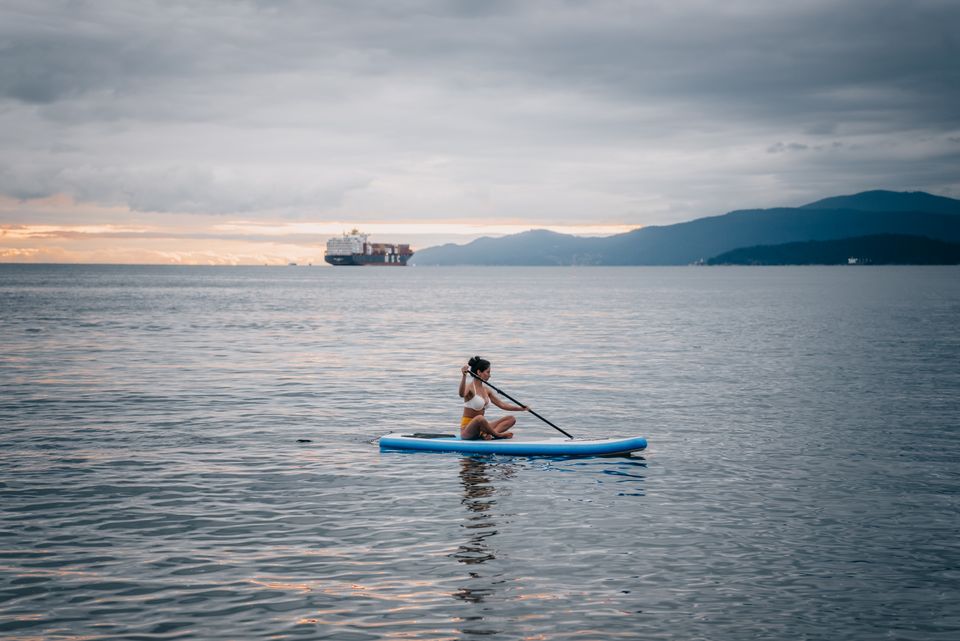
Kayaks are the better tool when the wind picks up, the chop builds or the trip stretches beyond 5 km. The lower seating position keeps the center of gravity low, which means a kayak handles 15 to 20 knots of wind that would knock a stand-up paddler off their board within minutes. The longer hull and double-blade paddle make sustained speed (6 to 8 km/h) easier than on a SUP (3 to 5 km/h).
Sit-on-top kayaks are the standard recreational format: open deck, self-draining, easy to remount after a swim. Sit-inside kayaks are warmer and faster for longer trips but require a spray skirt and a roll or wet-exit technique. For beach use with kids and casual paddling, sit-on-top is almost always the right choice. Tandem kayaks let two people share the work and bring kids along.
Kids and beginners on the water
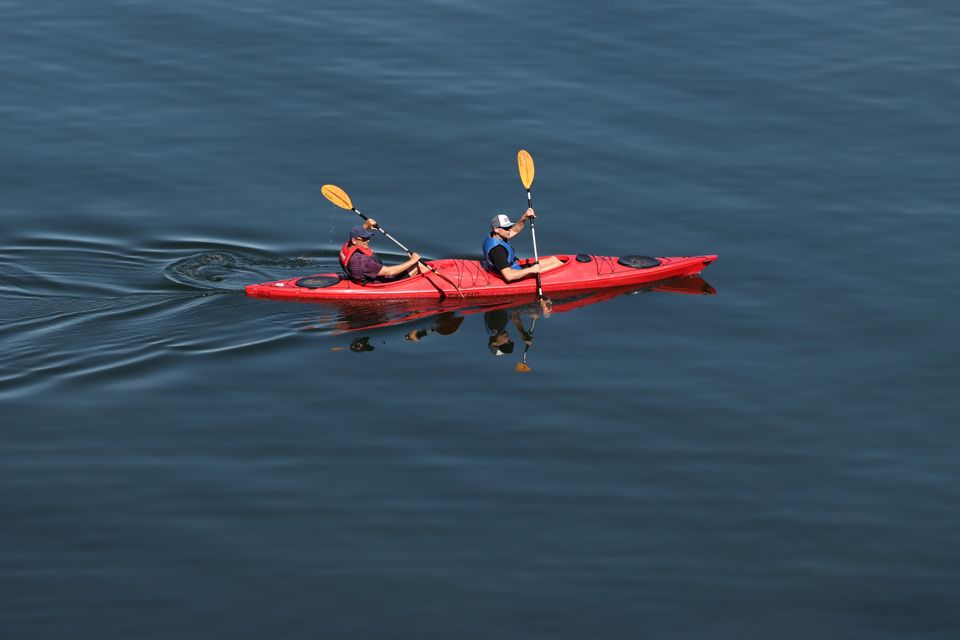
Kids under 8 are usually safer and more comfortable in the front seat of a tandem sit-on-top kayak. The seated position is stable, they cannot fall off easily and the adult in the back can control direction. SUP with kids works for older children (8+) on calm flat water, with a kid-size paddle or sharing the adult board. For toddlers and infants, neither is appropriate without a dedicated parent-child setup, calm conditions and a life jacket fitted for the child's weight.
Beginner adults learn SUP and kayak in roughly the same amount of time (one to two hours to become functional), but with different failure modes. SUP beginners fall in the water; kayak beginners get tangled in their paddle and bump the bow into things. Most rental places offer a short briefing that covers stance, paddle technique and basic safety, which is worth taking even if you have done it before.
- Kids under 8: tandem sit-on-top kayak, front seat, supervised.
- Kids 8 and over: SUP on calm flat water with kid paddle.
- Beginners: SUP and kayak both take 1 to 2 hours to become functional.
- Life jacket fitted for body weight, not just adult sizes.
Gear, storage and transport
An inflatable SUP package (board, paddle, leash, pump, backpack) costs roughly 350 to 700 EUR for a quality recreational model. A recreational sit-on-top kayak costs 500 to 1000 EUR plus a paddle (80 to 150 EUR). Kayaks are usually rigid plastic, which means a 3 to 4 meter object that needs a roof rack, a trailer, or a dedicated garage space. Inflatable kayaks exist but are slower than rigid ones and less stable than inflatable SUPs.
Rental is often the right answer for occasional users. Most European beach resorts (France, Spain, Italy, Portugal, Greece, Croatia) have rental shacks offering hourly or half-day rates for both SUP and kayak. Prices range from 10 to 25 EUR per hour. For a one-week holiday, rental is almost always cheaper than buying, transporting and storing gear.
- Inflatable SUP package: 350 to 700 EUR; easy storage and transport.
- Rigid kayak: 500 to 1000 EUR plus roof rack or trailer.
- Rental: 10 to 25 EUR/hour; usually cheaper than buying for occasional users.
- Always bring a life jacket sized for body weight, not vibe.
Reading the beach to choose the day
A practical decision routine looks like this: check the wind forecast (Windy, MeteoFrance, Windguru) for the planned beach. Below 10 knots, SUP is the default. Between 10 and 15 knots, lean kayak especially with kids. Above 15 knots, both crafts become work; consider a sheltered bay or a different activity. Add chop and swell to the picture: SUP loses much faster than kayak in choppy water.
Use BeachFinder to confirm beach orientation, swell exposure and amenities. A calm protected bay with a rental shack is the ideal beach for both SUP and kayak. An exposed Atlantic beach with 1 meter swell is rarely the right call for either in a recreational session. Reading the beach saves more sessions than any gear upgrade.
Before you go
- Check wind forecast: under 10 knots = SUP, 10 to 15 knots = kayak, above 15 = consider a different activity.
- Match craft to distance: SUP under 5 km, kayak above.
- For kids under 8, prefer tandem kayak over solo SUP.
- Wear a life jacket fitted for body weight on any water session.
- Rent before buying unless you already own a roof rack or garage.
FAQ
Is SUP or kayak easier for beginners?
Both take roughly one to two hours to become functional on calm water. SUP is more demanding on balance but more intuitive on technique. Kayak is more intuitive on stability but requires coordinating a double-blade paddle. Most adults can do either by the end of a first rental session. Children often prefer kayak because the seated position feels safer.
Can I take a SUP in the sea?
Yes, on calm sheltered days. The recreational SUP is designed for flat to moderate chop and wind under 10 knots. In open sea with swell, current and stronger wind, SUP becomes work fast and can be genuinely dangerous if you cannot get back to shore. Always check wind and swell forecasts, wear a leash, carry a phone in a waterproof pouch and stay within sight of shore.
How fast can I paddle a kayak vs a SUP?
A recreational kayak cruises at 6 to 8 km/h with moderate effort. A recreational SUP cruises at 3 to 5 km/h. The difference comes from hull design (longer kayak hull glides further per stroke) and propulsion (kayak double-blade paddle is more efficient than a single-blade SUP paddle). Touring kayaks can sustain 8 to 10 km/h, while racing SUP boards can reach 6 to 7 km/h.
Use BeachFinder to check today's spot.
Use your location, search any city worldwide or explore the map to compare the 20 most relevant beaches and swimming spots around you.
Download BeachFinder
Find beach conditions, sea temperature, wind, UV, water quality, and nearby swimming spots before you go.
These beach pages connect the guide advice with real spot details: sea temperature, wind, UV index, waves, access and photos when available.
Plage Gazagnaire
IT
Ondarreta
ES
Plage Rive Gauche
FR
Plage de la Dalle
FR
Plage de Saint-Jean
FR
Beach Baia Blu
IT
Hakuna Matata Beach
IT
Sunset Beach Club Palinuro
IT
La Luna-Royale Beach
ES
Playa del Regatón
ES
Platja gossos
ES
Playazo de Villaricos
ES
Playa Fluvial del Huerva
ES
Playa de Guadalmar
ES
la Caleta
ES