Best beginner beaches for stand-up paddle: how to choose
Calm bays, low wind, lake alternatives, equipment basics and where you should not start as a SUP beginner.
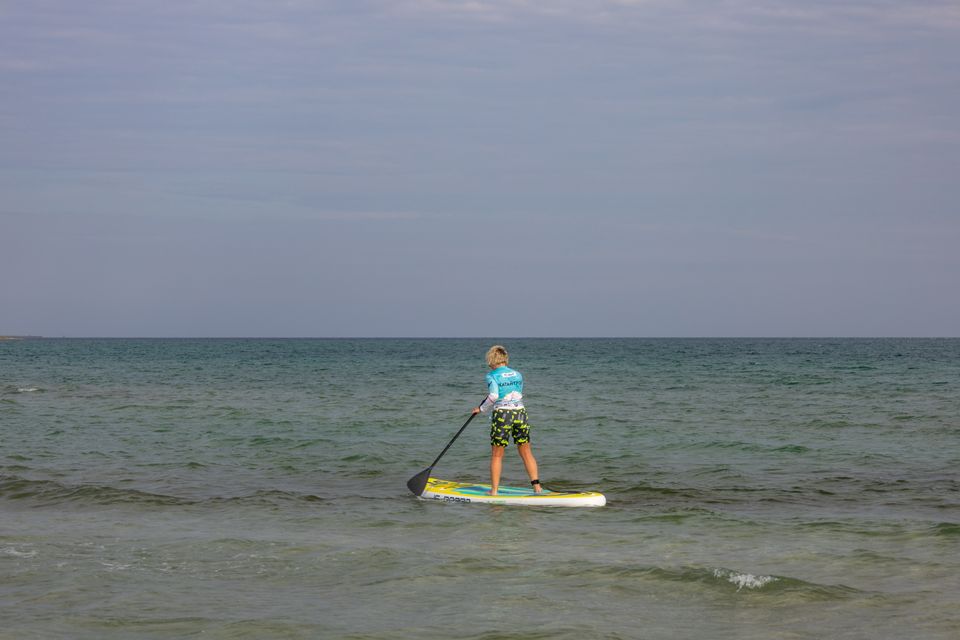
Stand-up paddle is the easiest watersport to start and the easiest to start in the wrong place. Most beginner accidents involve someone who underestimated wind, drifted out of a calm bay or rented a board on a popular beach with strong tidal flow. The water looked fine from the rental shop. It was not fine 200 meters offshore. Coastguards across Europe publish the same scenario every summer, and the people in trouble are almost always first-time paddlers who started in the wrong conditions, not bad swimmers.
BeachFinder is useful for SUP because the choice is mostly about wind, fetch and flow rather than wave height. A calm bay with consistent five-knot wind is far easier than an open ocean beach with light surf. A flat lake on a windless morning is even easier than that. This guide explains how to read those conditions and where to actually start. The summary, which works for almost everyone: pick a lake on a calm morning. Once you can stand for an hour, then graduate to a sheltered bay. Once you can paddle into wind for fifteen minutes without falling, then consider open coast.
- Wind decides everything: above 10 knots, beginner SUP becomes a paddle straight back to shore upwind.
- Calm bays, sheltered estuaries and lakes are the best beginner spots, in that order of forgiveness.
- Tide and current can pull a beginner offshore faster than most rentals warn: avoid offshore wind and ebbing tide on your first session.
- A leash is non-negotiable: the RNLI lists falling off and being separated from the board as the most common rescue cause.
Read wind before anything else
SUP is a flat-water sport. The board catches wind like a sail, and a beginner stance multiplies that effect. A five-knot breeze is barely noticeable. Ten knots requires effort. Fifteen knots is unmanageable for a first-time paddler, and twenty knots can blow a board offshore faster than the paddler can swim back. The wind speed at standing height on the water is usually slightly higher than the forecast wind speed at land-based stations, especially on open bays.
Check the forecast in knots, not just kilometers per hour. Online apps like Windy, Windguru and Meteo-France give clear readings. Aim for a morning session when wind is usually weakest. The afternoon thermal breeze on coastal France often reaches 15 to 20 knots between 14:00 and 17:00, exactly when many rentals close their busiest hours. The same effect happens on Italian and Spanish coastlines and on most large lakes: the morning is glass, the afternoon is whitecaps. Plan around that pattern rather than fighting it.
- Below 5 knots: ideal beginner conditions, especially on enclosed bays.
- 5 to 10 knots: manageable with experience, harder for first sessions.
- Above 10 knots: avoid as a beginner, particularly with offshore wind.
Avoid offshore wind, always
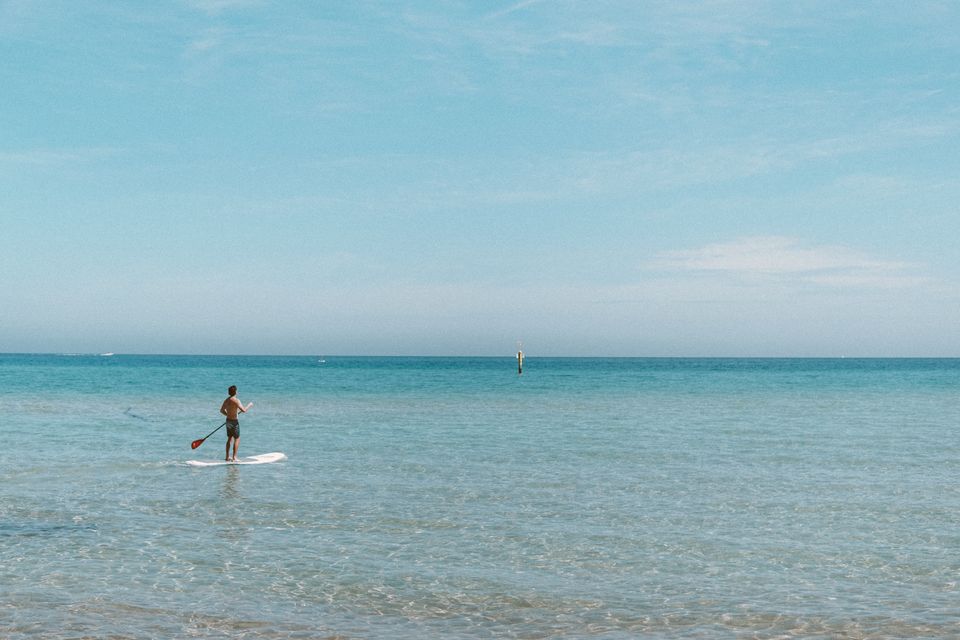
Offshore wind blows from the land toward the water. It looks like a calm beach: water close to shore is glassy, the wind is at your back when you launch, and the first ten meters feel easy. The trap is the return: you have to paddle directly into the wind, and a beginner cannot do that for more than a few minutes.
RNLI rescue data and American Canoe Association guidance both flag offshore wind as the leading cause of paddleboard rescues. The water near shore looks deceptively calm because the land blocks the wind there, not because the wind is weak. As soon as you leave the wind shadow, the wind hits you with full force.
Choose calm bays, estuaries and lakes
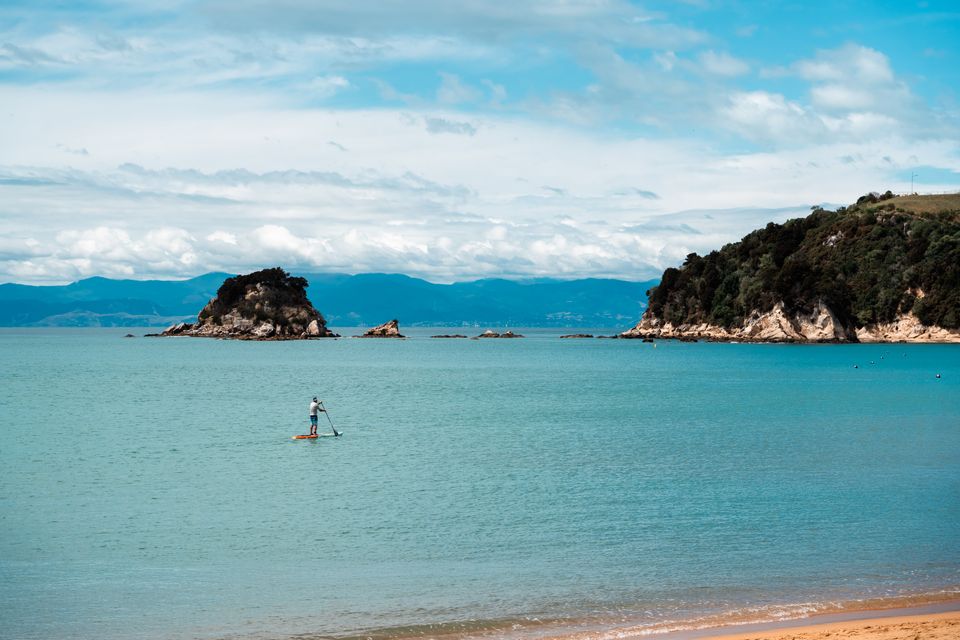
The most forgiving beginner SUP spots are enclosed bays with limited fetch (the distance over which wind builds chop), tidal estuaries with weak current, and inland lakes on calm mornings. France has hundreds of these: Etang de Thau, Bay of Arcachon, the Glenan archipelago in calm weather, lakes around Annecy and the Massif Central.
Open ocean beaches are usually harder. Even a small wave creates instability for a first-timer. A reef pass or surf zone amplifies that instability. Save those for after you have stood up reliably for an hour. The Federation Francaise de Voile and equivalents recommend starting on protected water and graduating outward only after basic balance is fluent.
- Best beginner: lake on a calm morning with no boat traffic.
- Good beginner: enclosed bay or estuary with sideshore breeze.
- Skip beginner: open ocean beach with surf, reef passes or strong tidal flow.
Equipment basics: leash, life jacket, board choice
A leash attached to the ankle or calf is the single most important item. Without it, a fall separates you from the board, and SUP boards drift faster than humans swim. The RNLI explicitly lists this as the leading rescue scenario. Coiled leashes are fine for flat water; straight leashes are used in surf only.
Life jackets (PFDs) are required by law in many countries and a good idea everywhere. France classifies SUP as a navigation activity, so beyond 300 meters from shore, a life jacket is legally required. Wide, soft-rail beginner boards (10 to 11 feet, 32 inches wide) are far more stable than the narrow performance boards rentals sometimes offer.
- Leash on every session: it stays attached when you fall.
- Life jacket required beyond 300 meters from shore in France.
- Choose a wide soft-rail beginner board (10-11 feet, 32+ inches wide).
Plan the route around the wind shift
Even on calm days, wind shifts during the session. Coastal thermal breezes pick up between 11:00 and 14:00. Lake afternoon winds often build with sun. The smart plan is to paddle into the wind first, while you are fresh, and let the wind help you on the return when you are tired.
Use BeachFinder to compare the photo, map, weather, UV, water temperature, wind, waves, currents, water quality where available, amenities, stays and activities before committing to the trip.
- Paddle into the wind first; let the easier part be the return.
- Set a turnaround time, not just a turnaround point.
- Tell someone on shore where you are going and when you will be back.
Before you go
- Check forecast wind in knots; below 10 knots is the beginner zone.
- Avoid offshore wind on every session, including calm-looking ones.
- Choose a lake, enclosed bay or estuary for early sessions.
- Wear a leash and a life jacket beyond 300 meters from shore.
- Paddle upwind first; tell someone your route and return time.
FAQ
Where should I start stand-up paddle as a beginner?
On a flat lake or an enclosed bay on a calm morning, with onshore or sideshore wind below 10 knots. Avoid open ocean beaches and any beach with offshore wind, surf, reef passes or strong tidal flow until you can stand reliably and paddle into wind for at least 15 minutes.
Is wind more dangerous than waves for SUP beginners?
Yes for most beginners. A board catches wind like a sail and offshore breezes drift paddlers offshore faster than they can paddle back. Waves are a stability problem you can fall safely into; offshore wind is a return-trip problem you may not solve. The RNLI and American Canoe Association both flag wind as the leading cause of SUP rescues.
Do I need a life jacket on a stand-up paddleboard?
In France, beyond 300 meters from shore SUP is classified as navigation and a life jacket is legally required. Even closer to shore, wearing one is strongly recommended for beginners. A leash is non-negotiable in any conditions: most SUP rescues involve a paddler separated from the board.
Use BeachFinder to check today's spot.
Use your location, search any city worldwide or explore the map to compare the 20 most relevant beaches and swimming spots around you.
Download BeachFinder
Find beach conditions, sea temperature, wind, UV, water quality, and nearby swimming spots before you go.
These beach pages connect the guide advice with real spot details: sea temperature, wind, UV index, waves, access and photos when available.
Plage Rive Gauche
FR
Plage de la Dalle
FR
Plage de Saint-Jean
FR
Plage du Lividic
FR
Plage de Notre-Dame
FR
David
FR
Plage du Moulin Brûlé
FR
Plage de La Folie Calette
FR
Plage du Tertre Pelé
FR
Plan d'eau de Chambaud
FR
Grands Sables
FR
Plage des Célestins
FR
Plage de Mousterlin
FR
Plage de Porsmeur
FR
Plage de la Phibie
FR