Summer storms at the beach: lightning, evacuation, jellyfish
When to leave the beach during a summer storm: the 30-30 lightning rule, evacuation timing, and what to expect for jellyfish in the days after.

Summer beaches are statistically the most dangerous places to be during a thunderstorm. You are in the open, often near water, and surrounded by metal umbrellas, beach buggies and antennas. NOAA's lightning safety statistics consistently rank beach activities in the top categories for outdoor lightning fatalities. The same storms also stir up the sea, change currents and drive jellyfish blooms toward the shore for 24 to 72 hours afterward.
This guide is the practical playbook for a summer storm. It explains the 30-30 rule that decides when to leave the beach, how long to wait before going back, the difference between a passing shower and a storm cell, and what to expect in the water for the days after the storm clears. The point is not to scare people off summer beaches; it is to make the decision easy when the sky changes.
- The 30-30 rule: leave the beach when thunder is within 30 seconds of lightning, and stay away 30 minutes after the last thunder.
- Evacuate to a closed building or hard-topped car; an umbrella, beach hut or open canopy is not shelter.
- Lightning can strike 10 to 15 km from the cell core; you do not need to be under the storm to be at risk.
- Expect jellyfish to drift toward shore in the 24 to 72 hours after a coastal storm.
The 30-30 rule and why it works
NOAA's lightning safety guidance for outdoor activities centers on the 30-30 rule. The first 30 counts the seconds between seeing the lightning flash and hearing the thunder. Sound travels about one kilometer in three seconds in warm air, so a 30-second gap means the lightning is roughly 10 kilometers away. Lightning can easily strike 10 to 15 kilometers from the storm cell core, so a 30-second gap is the inner edge of the danger zone. The second 30 says to wait 30 minutes after the last audible thunder before returning to the beach. Storm cells dissipate slowly, and the last lightning of a cell often comes from its receding back edge, where the sky may look clearer.
The simpler version, also from NOAA, is: 'When thunder roars, go indoors'. If you can hear thunder at all, lightning is close enough to hit you. The 30-second timing is the planning version; the simpler rule is the decision version. Both lead to the same action.
- If you can hear thunder, lightning is within striking range. Leave the water.
- 30-second gap between flash and thunder: storm is ~10 km away, evacuate the beach.
- Wait 30 minutes after the last audible thunder before going back.

Where 'shelter' actually means safe
A beach umbrella is not shelter. Neither is a wooden beach hut, an open-sided pavilion, a lifeguard tower or the underside of a pier. Lightning seeks the path of least resistance, and an isolated tall object becomes the path. Real shelter is a fully enclosed building with plumbing and wiring (so any strike is conducted to ground via the metal infrastructure), or a hard-topped car or van with the windows closed (the metal body acts as a Faraday cage).
If you cannot reach real shelter, the next best options are to get into a deep gully, ditch or low ground away from tall objects, crouch low without lying flat on the ground, and stay away from groups of people. Lying flat on wet sand is worse than crouching because more of your body is in contact with the ground, and ground currents from a nearby strike travel through it.
Why swimmers and surfers are the highest-risk group
NOAA's statistics consistently show that water activities (swimming, fishing, boating, surfing) account for a disproportionate share of lightning fatalities, especially on summer afternoons when convective storms build inland and drift to the coast. The reasons are physical: water conducts electricity efficiently, swimmers and surfers are higher than the surrounding flat water surface, and the impulse to wait out the storm is strong.
The two specific danger patterns are: a storm that builds behind the coastal cliffs or pines and rolls over the beach with very little warning (the classic Mediterranean afternoon cell), and a storm that approaches from offshore as a visible line of dark cloud (the classic Atlantic frontal storm). Both can produce lightning before the rain reaches the beach. If you wait for the first raindrops, you are already inside the danger window.
- Get out of the water at the first lightning, even if the rain has not started.
- Surfers: paddle in immediately, do not wait for the next set.
- Stand-up paddlers and inflatables: head for shore on the upwind side, not the open lagoon.
The rest of the storm: surge, current, debris
Lightning is the immediate killer, but a summer storm also changes the sea in less obvious ways. A short intense storm produces a localized wind surge that can push 1 to 2 meter waves onto a previously calm shore. Rip currents intensify or appear in new places as the wave-driven flow looks for an escape path. River mouths and storm drains carry runoff, debris and bacteria into the surf zone for 24 to 48 hours afterward, which is also why most municipal advisories cancel swimming after heavy summer rain.
The decision rule for the day after a summer storm is: read the water before you read the headline. A storm that produced 30 mm of rain on the coast usually means a 24-hour swimming advisory near any river mouth or drain. The sky may be perfect blue, the umbrella looks fine, and the lifeguard flag may still be yellow because the bacterial counts have not been measured yet.
Jellyfish after the storm
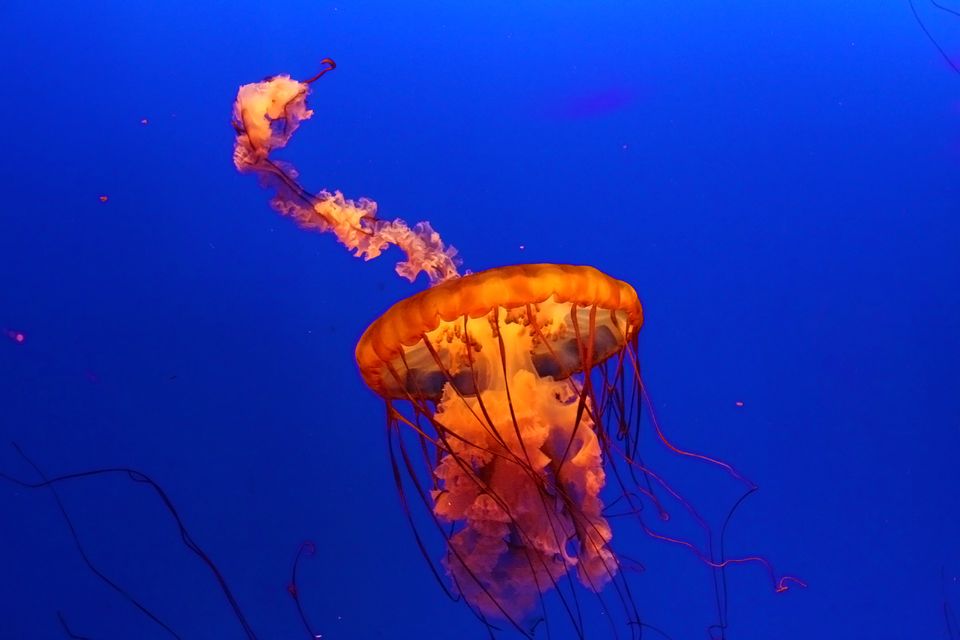
Mediterranean and Atlantic coasts both see jellyfish blooms drift toward shore in the days after a coastal storm. CIESM (the Mediterranean Science Commission) and Ifremer document the link: strong onshore winds and surface currents push pelagic jellyfish (Pelagia noctiluca, the most common Mediterranean stinger) into coastal waters, where they remain for 24 to 72 hours until winds shift. Atlantic coasts see similar drift events with Portuguese man-of-war on the Algarve and Galicia after strong southerly storms.
Practical impact: if a storm cleared 12 to 24 hours ago and the wind has been blowing onshore since, expect jellyfish near the surf zone. Look before you swim. Lifeguards usually fly a purple flag, or post a hand-drawn jellyfish sketch on the tower board, when a bloom has been confirmed. The risk is not life-threatening for most adults, but it ends a beach day quickly, especially for kids.
- Expect jellyfish in the 24 to 72 hours after a coastal storm with onshore wind.
- Look for purple flags or hand-drawn warnings on lifeguard towers.
- Vinegar (Med) or sea water rinse (Atlantic Portuguese man-of-war) are the first-aid baselines.
Plan with the spot page and the forecast
BeachFinder shows wind, weather, water temperature and water quality on the spot page. For a stormy day those signals together decide whether to commit. Meteo-France vigilance maps and NOAA NWS warnings are the upstream layer: if the regional vigilance is orange or red for thunderstorms, the safest move is to skip the beach. If the morning is fine but the inland forecast shows a 30 to 60 percent storm chance, plan a short beach window and have an evacuation route to your car or a building.
Use BeachFinder to compare the photo, map, weather, UV, water temperature, wind, waves, currents, water quality where available, amenities, stays and activities before committing to the trip.
Before you go
- Check Meteo-France vigilance or NWS warnings before leaving for the beach.
- Identify a real shelter (closed building or hard-topped car) before you set up.
- At the first thunder, leave the water and walk briskly to shelter; do not wait for rain.
- Stay away from the beach for 30 minutes after the last audible thunder.
- Watch for purple flags and jellyfish in the 24 to 72 hours after the storm clears.
FAQ
How far can lightning strike from the storm itself?
NOAA documents lightning strikes 10 to 15 kilometers from the storm cell core, occasionally more. That is why the 30-second rule (which corresponds to roughly 10 km) is the inner edge of safety. You do not need to be under the cloud to be at risk; you only need to hear the thunder.
Is a beach umbrella safer than nothing in a storm?
No. A beach umbrella is an isolated metal-spoked object on flat sand, and it can actually attract a strike. Leave the umbrella, walk briskly to a closed building or your car. Do not stand under it, do not hold it, do not gather under shared canopies.
How long after the storm can I swim again?
Wait 30 minutes after the last audible thunder for lightning safety. For water quality, wait 24 to 48 hours near river mouths and storm drains because runoff carries bacteria. For jellyfish, monitor the lifeguard flag and the water itself for 24 to 72 hours, especially if the wind has stayed onshore.
Use BeachFinder to check today's spot.
Use your location, search any city worldwide or explore the map to compare the 20 most relevant beaches and swimming spots around you.
Download BeachFinder
Find beach conditions, sea temperature, wind, UV, water quality, and nearby swimming spots before you go.
These beach pages connect the guide advice with real spot details: sea temperature, wind, UV index, waves, access and photos when available.
Plage Gazagnaire
IT
Plage Rive Gauche
FR
Plage de la Dalle
FR
Plage de Saint-Jean
FR
Beach Baia Blu
IT
Hakuna Matata Beach
IT
Sunset Beach Club Palinuro
IT
Plage du Moulin Brûlé
FR
Spiaggia grande di Tordigliano
IT
Baia dei Mergoli o delle Zagare - Nord
IT
Plage du Lividic
FR
Plage de Notre-Dame
FR
David
FR
Spiaggia di Marina d'Albori
IT
Plage de La Folie Calette
FR