
Parking at the beach in summer France: how to actually find a spot
Paid lots, time limits, arrival hours and the realistic rules for parking near French beaches in July and August.
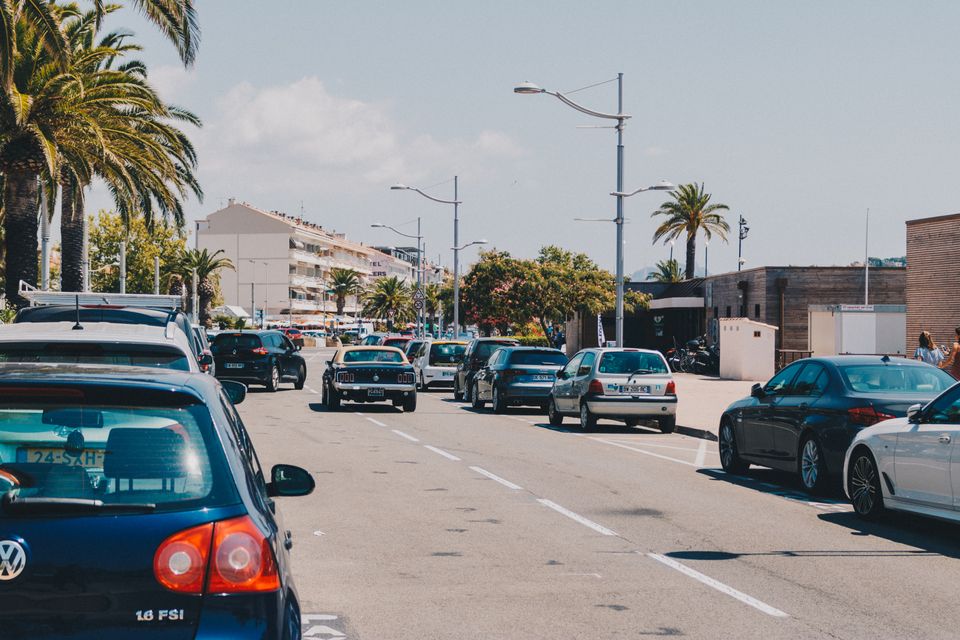
Parking is the part of a French beach day that travelers underestimate the most. The beach itself is free, the swim is free, and yet the trip can collapse before anyone touches the water because the only public lot has been full since 09:30 and the next available spot is two kilometers up a hot road. Every July and August, French Riviera communes publish the same complaints: cars parked on cycle lanes, residents blocked in, fire access lines violated. The result is more zoned parking, more paid lots and tighter enforcement every year. The beach access logic of 2018 no longer applies, and the family that arrives at 11:00 with a stroller and a cooler is now planning the day around the parking grid rather than the tide.
BeachFinder cannot park your car, but it can help you pick beaches where parking is realistic and time the visit around the windows that actually work. The rules vary by commune, but the patterns are consistent: arrive early, expect to pay, do not trust the closest lot and always have a plan B that is a five-minute walk away. This guide is the practical version of those patterns, with the specific cues that decide whether the day starts well or starts with a forty-minute loop around closed roads.
- Arrival before 09:30 is the single biggest factor: most beach lots in summer France fill by 10:00 and stay full until 16:00.
- Paid lots cost 3 to 8 euros per day in most coastal communes and are usually the only realistic option after 10:00.
- Time-limited blue zones (zone bleue) often allow only 2 hours and are not designed for a beach day, despite their convenient location.
- Towed cars cost 130 to 220 euros plus daily storage: never park on yellow lines, fire access strips or unauthorized residential streets.
Arrive before 09:30 in July and August
On the French Mediterranean and the Atlantic coast in high season, public beach lots fill between 09:30 and 10:30 on weekdays and even earlier on weekends. The window is narrow because the daytrip population is essentially predictable: families wake up, eat, drive, and arrive within the same two-hour band. A 09:00 arrival usually means a 100-meter walk from the car to the sand. A 10:30 arrival usually means a 600-meter walk through residential streets with no shade and no return route after lunch, because by the time you come back to the car the entire neighborhood is parked.
The afternoon picture is different. Many families leave between 14:00 and 16:00, and spots open up. If your group is fine with a 15:00 to 19:00 visit, parking pressure drops sharply and you also get softer UV, cooler sand and the warmest water of the day. This is the simplest scheduling trick on the French coast: trade the morning rush for the late afternoon, and the parking problem solves itself.
- Best signal: arrive between 08:30 and 09:30 for guaranteed access to the closest lot.
- Acceptable: arrive between 15:00 and 16:00 after the lunch rotation opens spots.
- Worst window: 10:30 to 13:30, when arrivals stack and no one is leaving yet.

Plan for paid parking, not for free spots
Free roadside parking near a famous beach is a 2010 idea. In 2026, almost every coastal commune from Collioure to Menton runs paid lots between June 15 and September 15, with daily rates between 3 and 8 euros. Some lots use a flat day rate, others charge hourly with a daily cap. A few high-pressure communes (Saint-Tropez, Cassis, Cap d'Antibes) now run 10 to 15 euro day rates in peak weeks, and the cheap municipal lot has often been converted to a private concession.
The price is rarely the problem. The problem is assuming there is a free option and then driving past three full paid lots before giving up. Service-Public.fr lists the legal framework for municipal parking and the commune sites publish the seasonal rates. Treat the parking budget as a non-negotiable line item, the same way you would treat a toll or a gas refill.
Read zone bleue and resident-only signs carefully
Blue zone parking (zone bleue) looks attractive because the spots are close to the beach and the meter is free. The trap is the time limit: most blue zones in coastal France allow only 90 minutes to 2 hours, controlled by a paper disc on the dashboard. A beach day is not a blue zone activity. The ticket for an expired disc is 17 euros, and on a heavy enforcement day patrols circle every 30 minutes.
Resident-only streets (riverains autorises) and pedestrian-restricted zones are another common mistake. Many coastal communes restrict streets near the beach to local residents during July and August, signed at the entrance and enforced by camera or patrol. Foreign plates do not get a pass. Read the small print on every white sign before you turn into a side street, and if the sign mentions resident permits or seasonal restriction, keep driving.
- Blue zones: 2-hour maximum, not a beach-day option.
- Resident-only streets: avoid, especially in July and August.
- Yellow curb lines: never park, fines start at 35 euros and towing is common.
Use park-and-ride and shuttle systems
Several busy French beach communes have rolled out park-and-ride systems with summer shuttle buses. The Calanques near Marseille, the Bay of Saint-Jean-de-Luz, the beaches around Cassis and parts of Cap d'Agde run free or low-cost shuttle buses from outlying lots between July 1 and September 1. The lots are usually 5 to 15 minutes outside the beach by bus, and the shuttles run every 15 to 30 minutes.
The advantage is double: the parking is cheaper (often 2 to 4 euros for the day) and the closest beach lots are reserved for residents or shuttle bypass. This is now the most reliable way into the Calanques de Marseille between July 1 and August 31, and the difference between using the shuttle and trying to drive in is often the difference between a 10-minute walk to the water and a two-kilometer climb back uphill at 16:00.
- Check commune websites for navette des plages or park-and-ride options.
- Calanques, Cassis, Cap d'Agde and many Riviera communes run summer shuttles.
- Shuttle parking is often the only realistic option after 09:30 in peak weeks.
Have a plan B and a leave time
If the first lot is full, do not loop. Looping costs 15 minutes per attempt and rarely succeeds. Instead, save two backup beaches in BeachFinder within a 15-minute drive, each with a different parking pattern: one main beach with paid lots, one secondary beach with free roadside parking outside the main town. The secondary beach is usually less famous and often less crowded too.
Use BeachFinder to compare the photo, map, weather, UV, water temperature, wind, waves, currents, water quality where available, amenities, stays and activities before committing to the trip.
- Save two backup beaches within 15 minutes, with different parking patterns.
- Set a clear leave time before 14:00 to keep the afternoon rotation open.
- Photograph your parking spot and lot reference before walking to the sand.
Before you go
- Arrive before 09:30 on weekdays, earlier on weekends in July and August.
- Budget 5 to 10 euros for paid parking per beach day.
- Avoid blue zones, resident streets and yellow curbs.
- Check for park-and-ride shuttles on the commune website before leaving.
- Save two backup beaches with different parking patterns within 15 minutes.
FAQ
Is parking free at most French beaches in summer?
No. Between mid-June and mid-September, most coastal communes from the Atlantic to the Mediterranean run paid lots, typically 3 to 8 euros per day. A few free roadside spots remain on secondary beaches, but the main bathing beaches near famous towns charge for parking and enforce time limits on blue zones.
What time should I arrive at a beach in France in August?
Before 09:30 for guaranteed access to the closest lot, or after 15:00 once the lunch rotation opens spots. The 10:30 to 13:30 window is when arrivals stack without anyone leaving, and it is the most stressful time to find parking.
Can my car get towed near a French beach?
Yes. Towing fees are typically 130 to 220 euros plus daily storage. Avoid yellow lines, fire access strips, resident-only streets and pedestrian zones. Foreign plates do not get a pass, and patrols on famous beaches operate every 30 minutes during high season.
Use BeachFinder to check today's spot.
Use your location, search any city worldwide or explore the map to compare the 20 most relevant beaches and swimming spots around you.
Download BeachFinder
Find beach conditions, sea temperature, wind, UV, water quality, and nearby swimming spots before you go.