
Beach safety flags by country: France, Spain, Portugal, Italy, UK, US
Red, yellow, green, checkered and purple flags do not mean the same thing everywhere. A guide to lifeguard flag systems across six major beach countries.
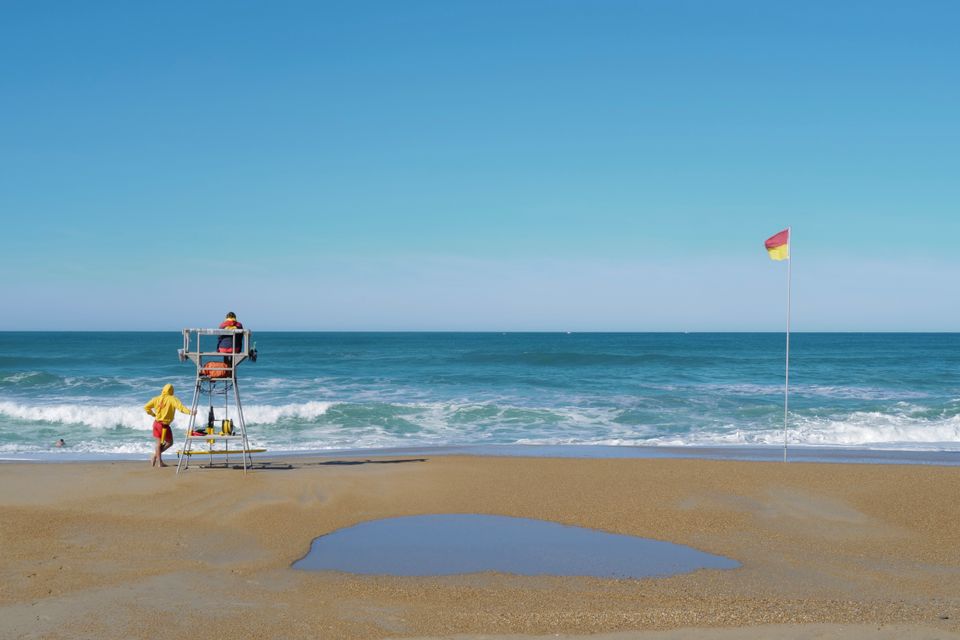
Beach flags look like an international language, and they almost are. The International Life Saving Federation publishes a recommended scheme, the ISO 20712 standard formalizes the colors, and most major beach countries follow at least the basics. The catch is that the details vary, and the differences matter on the day. A red flag in France is not the same as a red flag in the United States.
This guide walks the flag systems used across France, Spain, Portugal, Italy, the United Kingdom and the United States. It is not a substitute for what the lifeguard says on the day. It is a way to read the flags faster on the first beach of a trip, especially in countries you do not visit often.
- Red and yellow checkered (red-and-yellow quartered) flags mark the lifeguarded swim zone in most countries.
- A solid red flag almost always means swimming is forbidden or strongly discouraged.
- A purple flag means dangerous marine life (jellyfish, sharks) in the US, but is not used everywhere.
- Green flags are not universal: France uses them, the UK does not.
The international baseline (ILS / ISO)
The International Life Saving Federation publishes a global beach flag system, and ISO 20712-1 codifies the colors. The baseline is: red and yellow quartered flags mark the lifeguarded swim zone, a black and white quartered flag marks the surfing or watercraft zone, a solid red flag means no swimming, and a yellow flag means caution. Most beach countries adopt this baseline, but each adds extras.
Where it gets interesting is the details below the baseline: green flags, double red flags, purple flags, blue flags (which are not safety flags at all), and special flags for jellyfish, sharks or swimming bans. Local lifeguards often communicate orally on top of the flags, so always read the chalkboard or sign at the lifeguard tower if there is one.
- Red and yellow quartered: lifeguarded swim zone.
- Black and white quartered: watercraft and surf zone, no swimming.
- Solid red: no swimming.
- Yellow: caution, hazardous conditions.
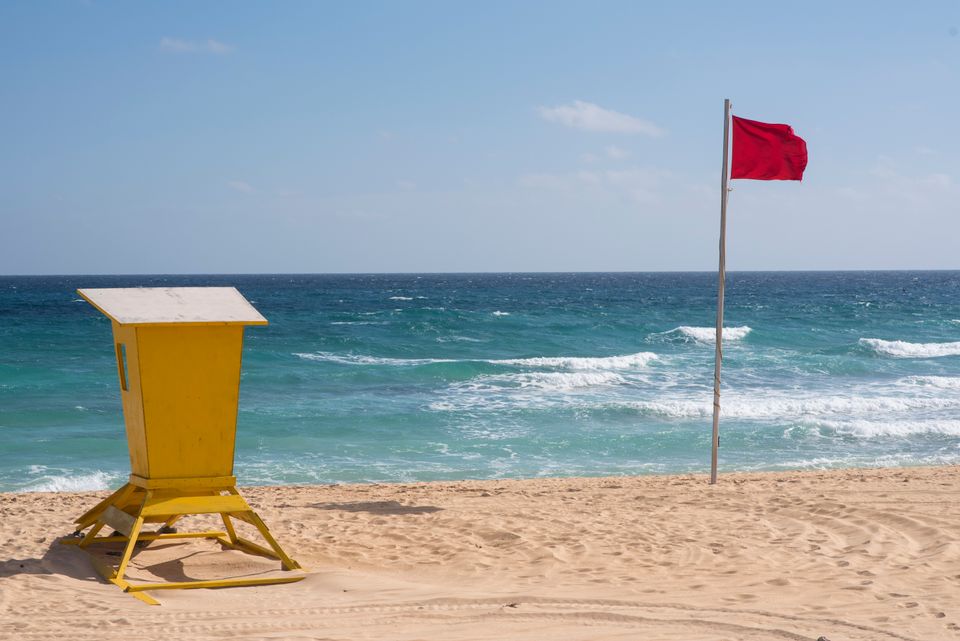
France: drapeau de baignade
French beaches use a three-color flag for swimming itself: green (baignade surveillee, swimming allowed and supervised), yellow (baignade dangereuse mais autorisee, allowed but dangerous), red (baignade interdite, swimming forbidden). The flag flies near the lifeguard post, and a separate red and yellow quartered flag may mark the supervised zone within the beach. SHOM and Meteo-France document this scheme on their bathing safety pages.
Two important nuances. First, the green flag is not a guarantee of calm water; it means the conditions are within normal range and lifeguards are on duty. Second, an orange or yellow flag is the most ambiguous: swimming is allowed but you should be confident and watch your kids closely. Many drownings in France happen on yellow-flag days, not red-flag days, because people assume yellow equals safe.
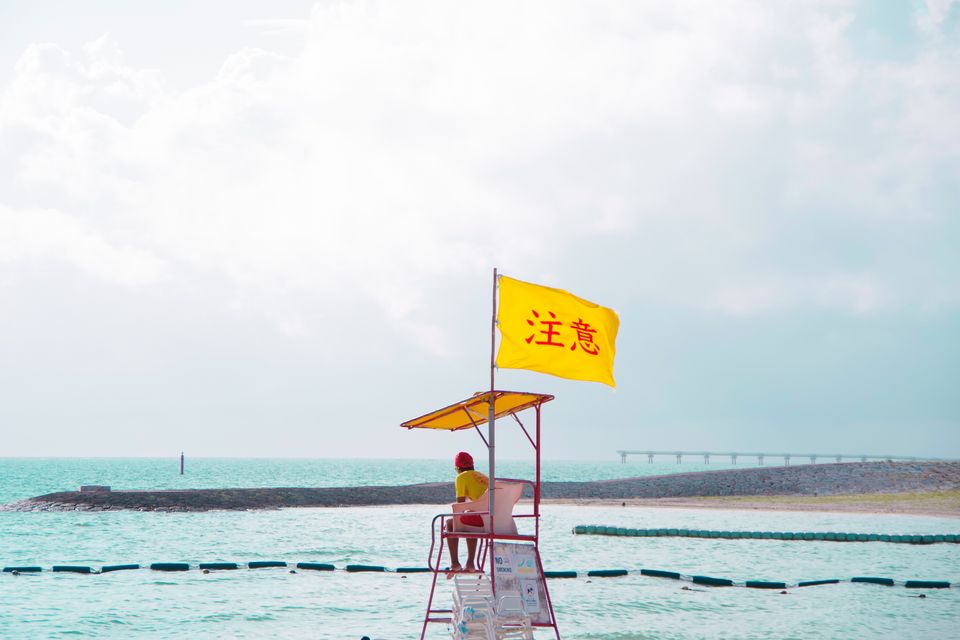
Spain: bandera roja, amarilla, verde
Spain uses a similar three-color scheme: bandera verde (green, swim freely), amarilla (yellow, swim with caution), roja (red, swim banned). It is enforced by municipal lifeguards in coordination with local civil protection and the maritime authority. Same nuance as France: yellow does not mean safe, it means be careful, and lifeguards may close subzones with localized red flags even if the overall flag is yellow.
Some Spanish beaches add an extra purple or black flag for jellyfish or pollution events. AEMET publishes weather and sea state guidance, but the flag at the beach is set by the local lifeguard service based on what they actually see that day.
Portugal: similar to Spain, with red dominant
Portugal uses the same green/yellow/red system as Spain and France for swim status. Portuguese beaches see frequent yellow and red flags because of strong Atlantic exposure, especially from October through April. A red flag on a Portuguese beach often coexists with surfers riding outside the swim zone; that does not change the swim ban for the unsupervised public.
Portuguese lifeguard authorities are particularly strict about the difference between bathing zones and surf zones. The black and white quartered flag marks where surfers can paddle out and where swimmers should not be. If you are swimming in the wrong zone you will be asked to move, even if conditions look fine to you.
Italy: regional variation, often with extras
Italy follows the green/yellow/red system at most lifeguarded beaches, but enforcement varies regionally. The Italian Coast Guard and municipal lifeguards (bagnino) coordinate, and many private beach clubs (stabilimenti balneari) set their own flag at the entrance. On busy stretches you can see different flags 200 meters apart along the same stretch of sand.
Italy is also one of the countries where jellyfish flags appear most often, especially in the Adriatic during late summer. The flag is usually a sketch of a jellyfish on a white background or a purple flag, depending on the operator. If you are unsure, ask the local bagnino; they monitor the water hourly.
United Kingdom: RNLI flag system
The UK uses the RNLI flag system on lifeguarded beaches: red and yellow quartered marks the supervised swim zone, black and white quartered marks the watercraft zone, solid red means no swimming, and an orange windsock means inflatables should not be used. The UK does not use a green flag. Absence of red is not a green light.
Two specific UK additions: the orange windsock for offshore wind is unique and important, and an additional purple flag is used to indicate dangerous marine life. Outside lifeguarded hours, no flags fly even if conditions are dangerous, which is one reason the RNLI repeatedly emphasizes swimming between the red and yellow flags during the patrolled window.
- Red and yellow: lifeguarded swim zone (the zone you should be in).
- Black and white: watercraft and surf zone, do not swim.
- Solid red: do not swim.
- Orange windsock: do not use inflatables (offshore wind).
United States: NWS beach warning flags
The US uses a national NWS beach warning flag program with single, double and purple variants. A single solid red means high hazard, often equivalent to no swimming for most visitors. A double red means the water is closed to the public. A yellow flag means medium hazard. A green flag, where used, means low hazard. A purple flag means dangerous marine life such as jellyfish or sharks, used in Florida and along the Gulf Coast.
The US is the country where the purple flag is most familiar, but coverage varies state by state and beach by beach. Hawaii adds shark advisories. California adds rip-current-specific signs. Always read the lifeguard tower board and the beach entry sign in addition to the flag itself.
How to use this on the day
On any beach trip, the first stop should be the lifeguard tower or the sign at the entrance, not the umbrella. Identify the flag, identify the supervised zone, and check the chalkboard for any extra notes. If there is no lifeguard, treat that as a yellow signal in itself: you are responsible for your own assessment, and structural rips, currents and weather can change quickly.
Use BeachFinder to compare the photo, map, weather, UV, water temperature, wind, waves, currents, water quality where available, amenities, stays and activities before committing to the trip.
- Always read the flag before entering, even if locals are already in the water.
- If the country is unfamiliar, take 30 seconds to confirm what each color means.
- Treat yellow as caution, not as safe.
- Treat the lifeguarded zone (red and yellow quartered flags) as the default safe area.
Before you go
- Identify the country's specific flag system before the first swim of the trip.
- Always swim inside the red and yellow quartered zone when one is set up.
- Treat yellow flags as 'be careful', not as a green light.
- Watch for purple flags in the US and parts of Italy (dangerous marine life).
- Read the lifeguard chalkboard or sign in addition to the flag.
FAQ
Does a green flag really mean safe?
Green means the conditions are within normal range and lifeguards are on duty. It does not guarantee that today's water is calm, that there are no rip currents or that swimming is risk-free. Combine it with the live data on the spot page and your own visual check before entering.
Why are there no flags at some beaches?
Many small or remote beaches are not lifeguarded. Absence of flags does not mean conditions are good or bad; it means there is no one assessing them on the day. Treat unguarded beaches with extra caution, especially with children or in unfamiliar countries.
What is the difference between a Blue Flag and a safety flag?
They are unrelated. The Blue Flag is a quality and management certification awarded annually by the Foundation for Environmental Education. The red, yellow, green, purple and quartered flags are live safety flags set by lifeguards on the day. A Blue Flag beach can still fly a red flag in bad weather.
Use BeachFinder to check today's spot.
Use your location, search any city worldwide or explore the map to compare the 20 most relevant beaches and swimming spots around you.
Download BeachFinder
Find beach conditions, sea temperature, wind, UV, water quality, and nearby swimming spots before you go.
These beach pages connect the guide advice with real spot details: sea temperature, wind, UV index, waves, access and photos when available.
La Luna-Royale Beach
ES
Ondarreta
ES
Plage Rive Gauche
FR
Plage de la Dalle
FR
Plage de Saint-Jean
FR
Grande Blue Beach
TR
Playa del Regatón
ES
Platja gossos
ES
Playazo de Villaricos
ES
Playa Fluvial del Huerva
ES
Playa de Guadalmar
ES
la Caleta
ES
Praia das Furnas
ES
Praia de Rochas Brancas
ES
Platja de la Platera
ES